
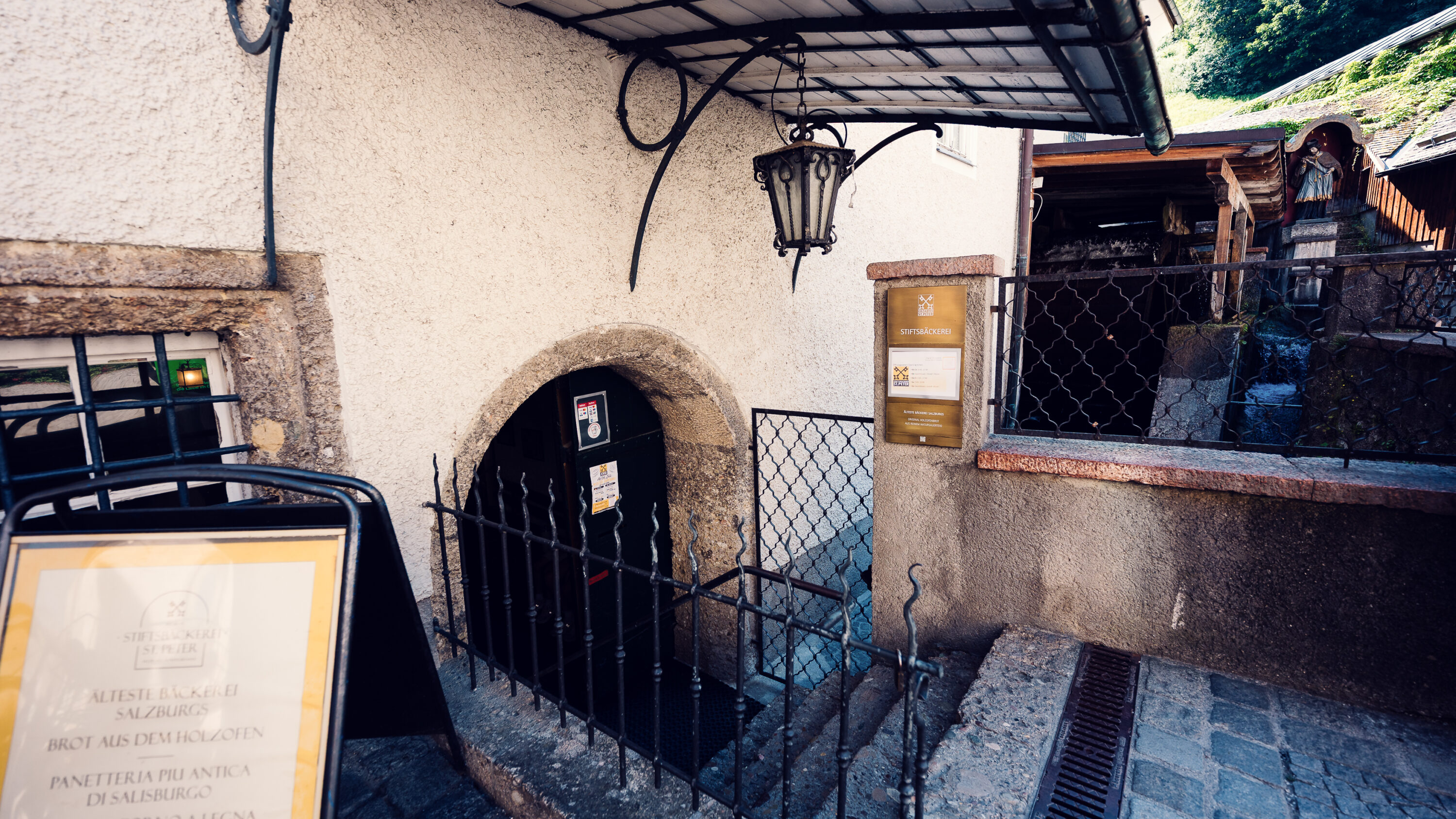
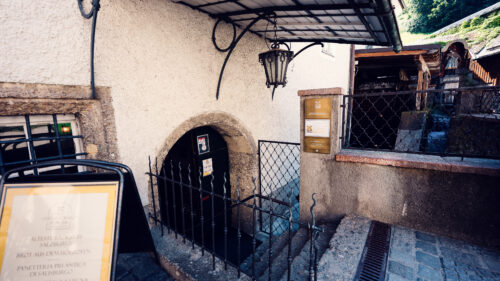
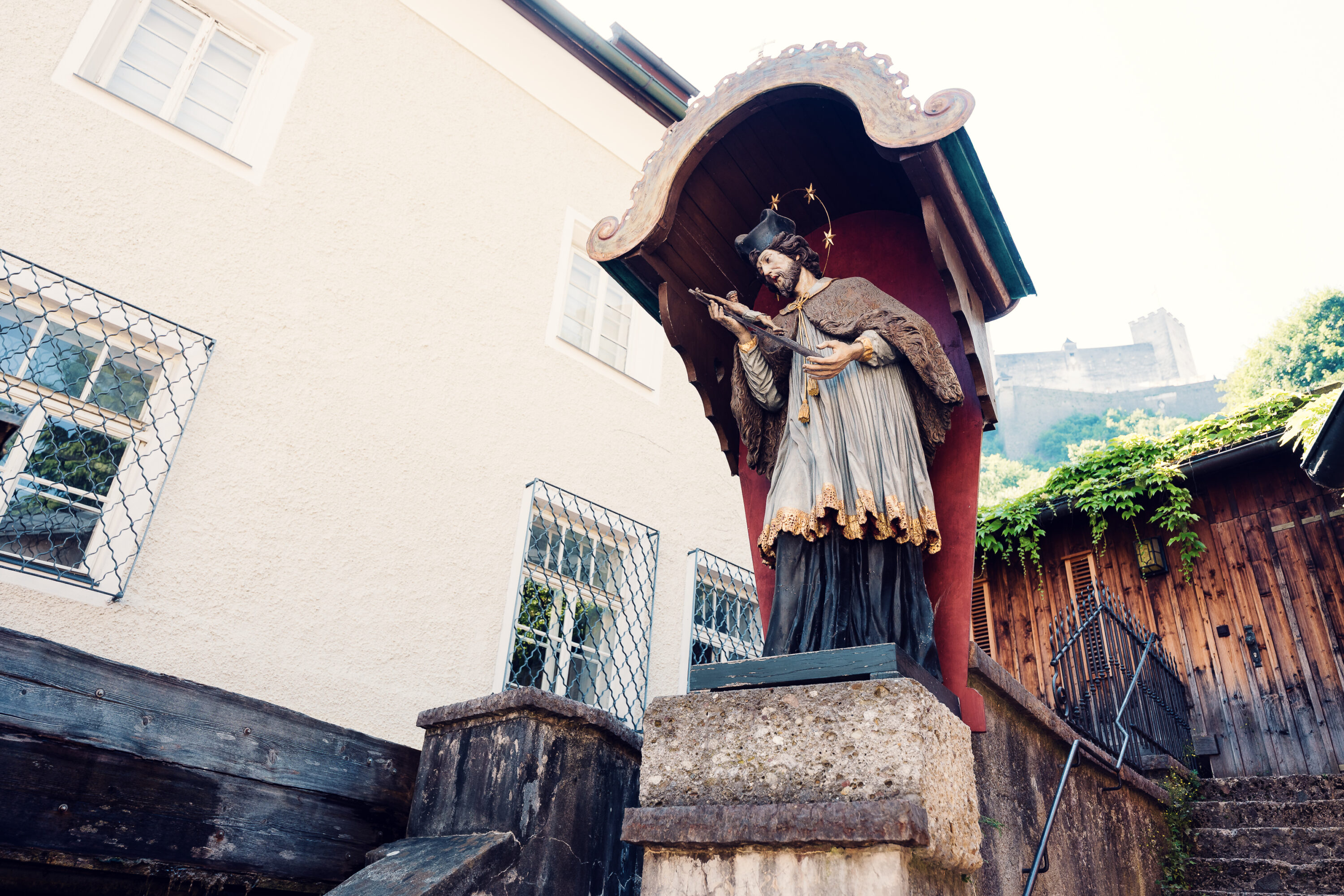
Entrance to the Stiftsbäckerei St. Peter with an arched stone doorway, wrought-iron railings, and a lantern above the steps.
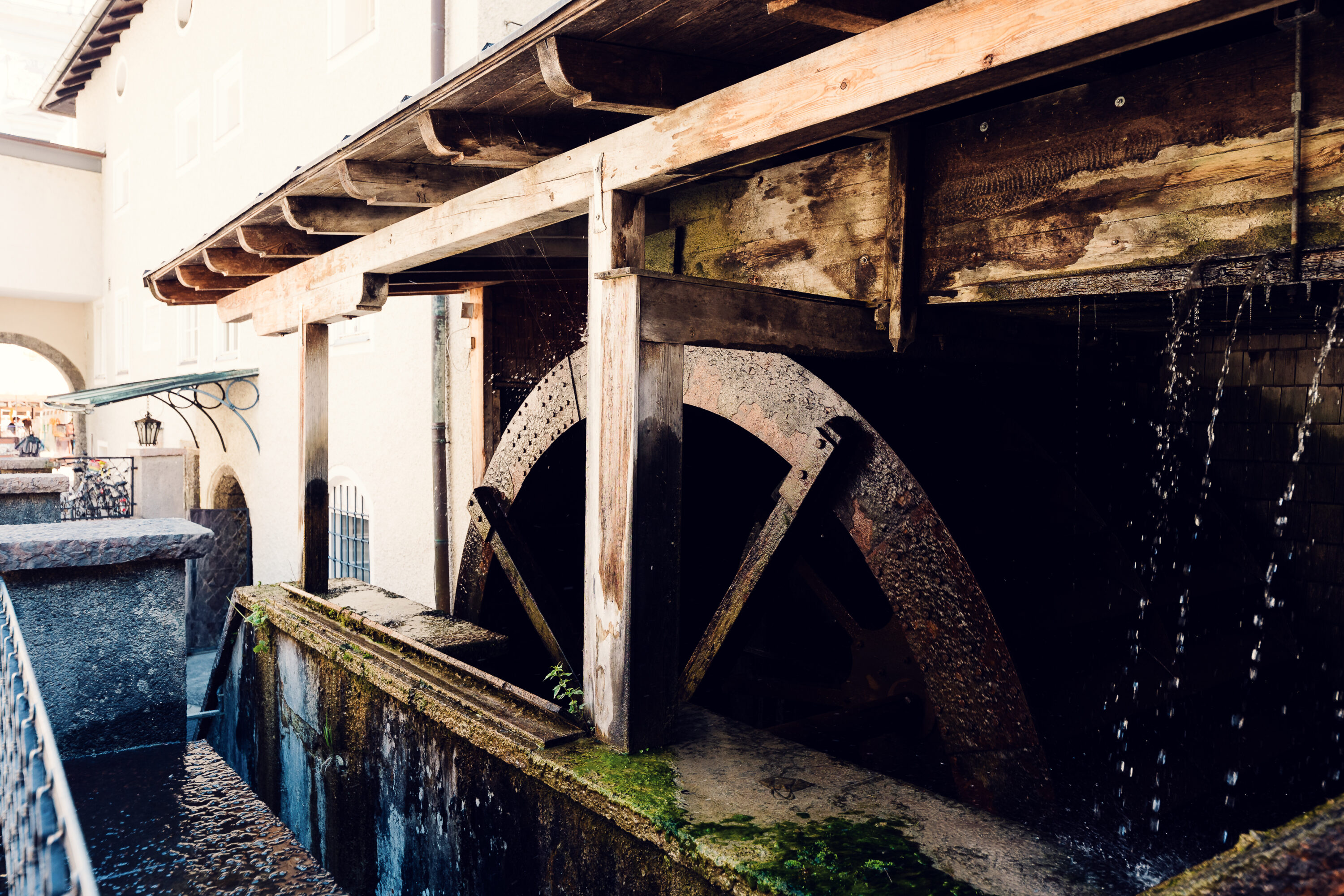
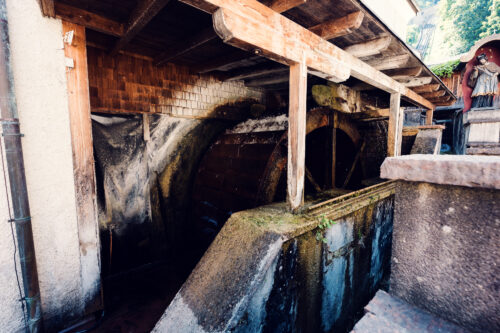
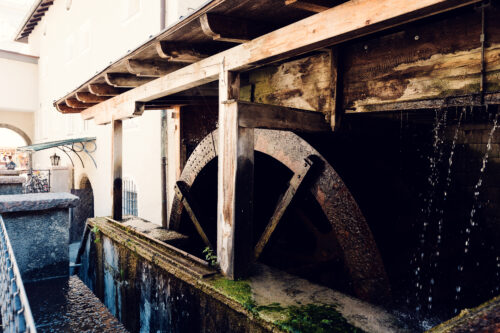
Wooden waterwheel of the Stiftsbäckerei St. Peter seen through the mill passage, with water cascading on the right.
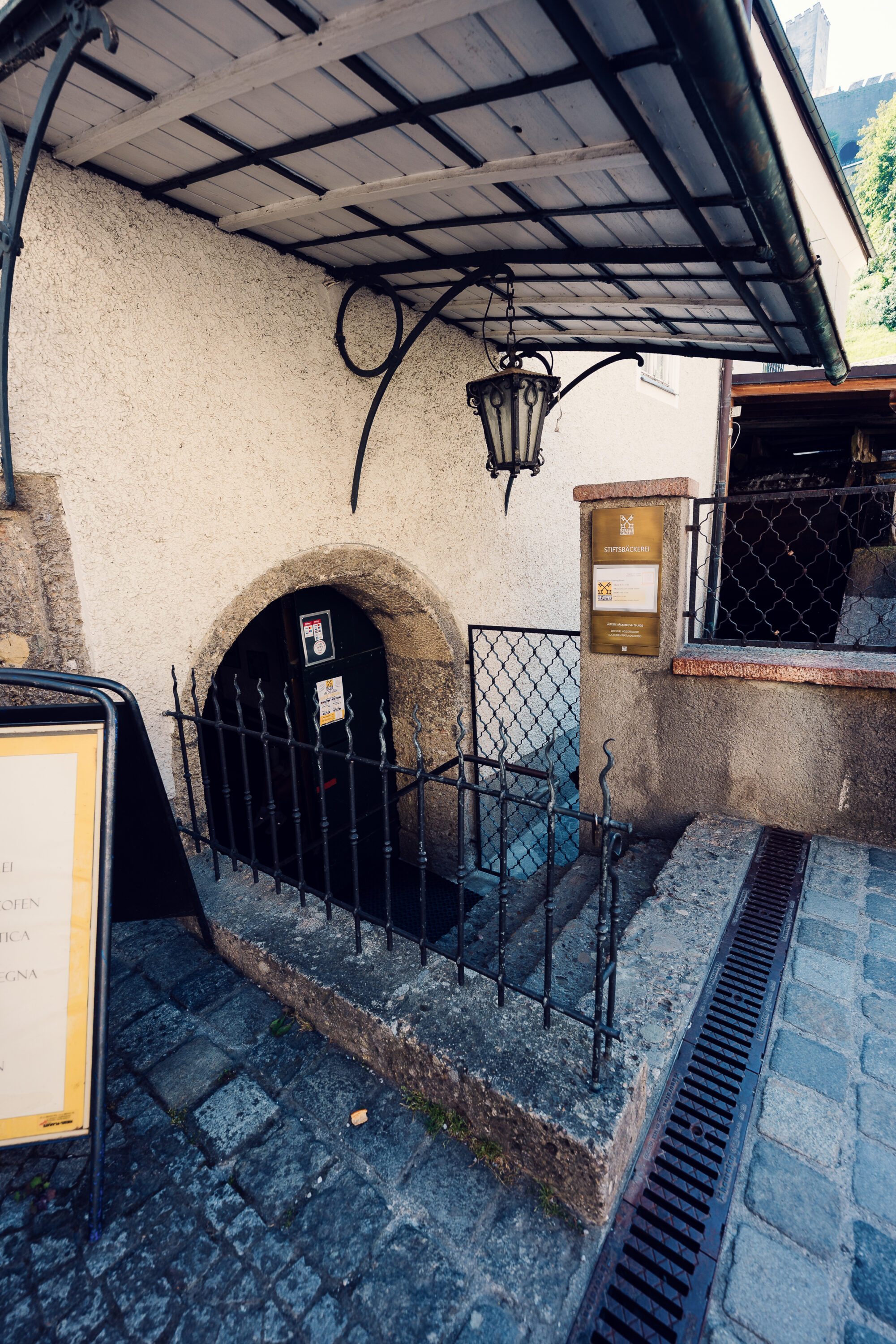
Front view of the Stiftsbäckerei St. Peter with its canopy and cobblestone forecourt, Hohensalzburg Fortress in the background.
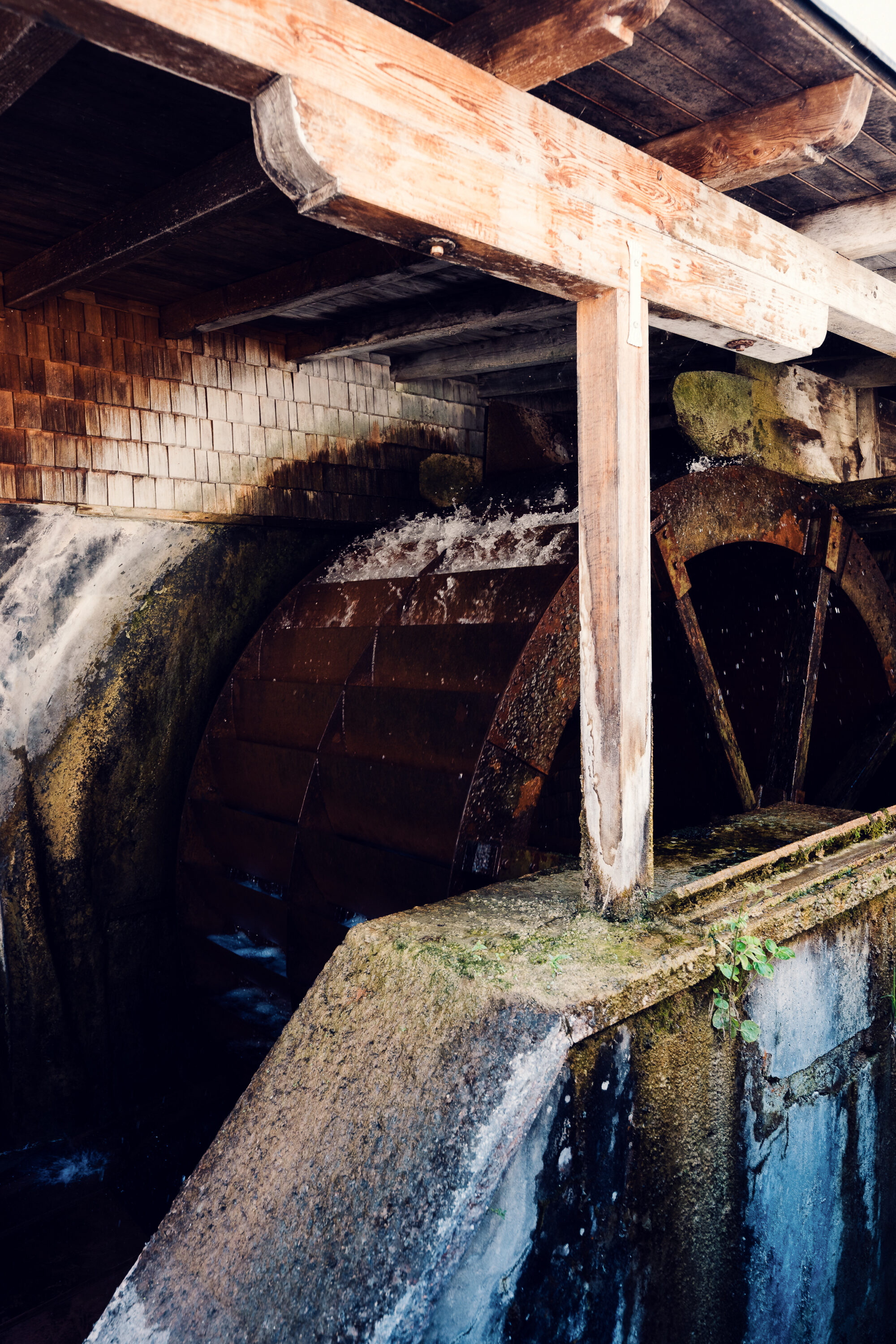
Close-up of the iron mill wheel at the Stiftsbäckerei St. Peter with water splashing over its paddles.
Fall in Love with

Stiftsbäckerei St. Peter

The Stiftsbäckerei St. Peter is Salzburg's oldest bakery, known for wood-fired sourdough bread and a baking tradition dating to the 12th century.

* Affiliate links: if you book, a small commission supports our independent work, at no extra cost to you.

01 / 02
01 / 02

Stiftsbäckerei St. Peter

Plan for
30 mins
Where
Old Town

The Stiftsbäckerei St. Peter is Salzburg's oldest bakery and one of the few places in Austria where bread is still baked the way it was centuries ago. Located at Kapitelplatz, by the entrance to St. Peter's Cemetery, the bakery belongs to the Benedictine Archabbey of St. Peter; its first written record dates to the 12th century, and it stands for more than 700 years of baking tradition. The shop and the bakehouse are one and the same room - a low-vaulted stone space where you can watch the bakers work while the scent of fresh rye bread fills the air. Everything here runs on tradition: rye flour ground in the on-site stone mill, energy from the Almkanal, wood from the abbey's forests, and a directly fired wood oven used for the bakery's signature bread. The bakery's signature product is a dense, dark sourdough loaf made from just three ingredients - rye flour, water, and salt. It's a place that feels untouched by time, and the bread tastes like it.

Plan your visit

Opening Hours
Tue - Wed 08:30 - 17:00  Thu - Fri 07:45 - 17:00  Sat 07:45 - 13:00  Sun - Mon closedAll hours
Getting there
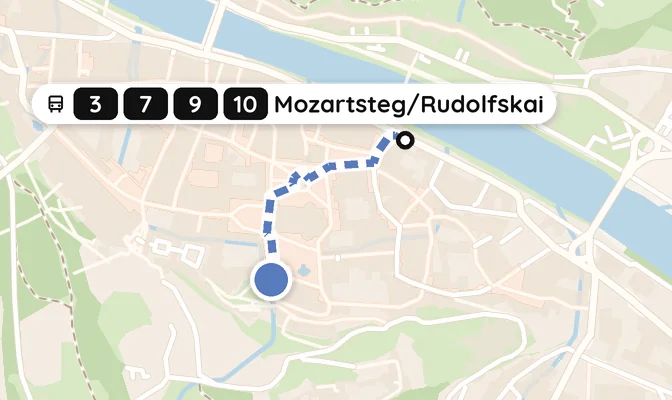
Kapitelplatz 8, 5020 SalzburgBus 3 7 9 10 Mozartsteg/Rudolfskai · 6 min walkOld Town
Good to know
Website · stiftsbaeckerei.at

Opening hours

Stiftsbäckerei St. Peter

MondayClosed
Tuesday08:30 - 17:00
Wednesday08:30 - 17:00
Thursday07:45 - 17:00
Friday07:45 - 17:00
Saturday07:45 - 13:00
SundayClosed

Tours & experiences

Stiftsbäckerei St. Peter


Muvamo Opinion

The first thing you notice is the smell. Before you even step through the heavy wooden door, the air around Kapitelplatz carries a warm, yeasty undertone that gets stronger the closer you get. Inside, you're standing in a working bakehouse shaped by more than 700 years of baking tradition, with low stone vaults, a hot oven, and the feel of a place still used exactly for its original purpose.

If you time it right, you'll catch the bakers pulling loaves from the oven with long wooden paddles. There's usually a small crowd waiting, locals mostly, some with cotton bags they've clearly brought for this exact purpose.

The bread here speaks for itself. The Schwarzbrot - also known locally as St.-Peterer-Brot - is a pure natural-sourdough rye bread made with rye flour, water, and salt, using flour milled on site and baked in a directly fired wood oven. You taste the difference.

Beyond the sourdough, the range stays deliberately small - Vintschgerl, Gewürzweckerl, and a brioche-style Milchbrotstriezel in wheat or spelt. During Christmas, they add Früchtebrot. Many items can sell out quickly, especially the Schwarzbrot on busy mornings. On Saturdays, a queue forms before the doors open, and the rye bread is often gone by late morning.

The real draw here goes beyond the bread. The sales counter sits in the bakehouse. The mill stands in the entrance hall. The waterwheel turns right outside the door. You can trace the journey from grain to loaf in the space of a few steps. For a city full of Mozart-branded confections and polished café culture, the Stiftsbäckerei St. Peter reminds you that Salzburg's food heritage runs far deeper - and far simpler - than chocolate balls and Sachertorte.

Come early and don't skip the brioche if it's still warm.

Recommended tours & experiences

  • Flavors of Salzburg: Private Food Tour: A three-hour guided food tour through Salzburg’s Old Town, featuring traditional Austrian dishes and local beer, with stops at market vendors, a pub, a bakery and a restaurant.

Helpful Hints

  • The bakery is closed on Wednesdays and Sundays. Fresh rye bread comes out around 7:45 AM on Thursdays, Fridays, and Saturdays, and around 8:45 AM on Mondays and Tuesdays.
  • The rye bread sells out quickly, especially on Saturdays. Arrive within the first hour of opening for the best selection.
  • The entrance from Kapitelplatz passes right by the waterwheel and stone mill. Don't walk past too fast.
  • Combine your visit with the Festung Hohensalzburg funicular station, which is close by.

Gastronomic Discoveries

  • The Schwarzbrot (dark rye sourdough) is the star.
  • The Milchbrotstriezel (braided milk bread) comes in pure wheat or pure spelt. If it's still warm from the oven, it's one of the best things you'll eat in Salzburg.
  • Vintschgerl are small, dense flatbreads with a pronounced rye flavor - perfect for pairing with cheese or cold cuts from the Getreidegasse shops.
  • During Advent, the bakery produces Früchtebrot - a seasonal fruit bread worth timing your visit for.
  • Grab a warm Gewürzweckerl (spiced roll) as an on-the-go snack while exploring the St. Peter district.

Hidden Gems

You can watch the bakers at work and see the stone mill in the entrance hall - the bakery makes no effort to hide its process, which is part of its appeal.

Our Little Extras

  • The Stiftsbäckerei uses wood from the forests of St. Peter's Abbey, energy from the Almkanal, rye flour ground in its own stone mill, and wheat flour from the Stifts- und Salzachmühle. The supply chain is still unusually traditional, though individual details have changed over time, including flour supply and the modern use of hydropower.
  • In September, the Almkanal is drained for annual maintenance (locally called "Almabkehr"), and you can walk through the 12th-century tunnel system that feeds the bakery's waterwheel.

From Medieval Monks to Modern Loaves - Stiftsbäckerei St. Peter

The story of the Stiftsbäckerei St. Peter begins not with bread, but with water. In the mid-12th century, under Archbishop Konrad I, engineers carved a 400-meter tunnel - the Stiftsarmstollen - through the Mönchsberg to divert the Almkanal into the city. At the point where the water emerged from the rock, the monks of St. Peter's Abbey built a grain mill and, beside it, a bakery. The Stiftsbäckerei St. Peter grew from this combination of flowing water, milled grain, and wood-fired baking - a production logic that still defines the bakery today.

The monks of the Benedictine Archabbey had likely baked bread since the monastery's founding, but the documented history of the mill dates to around 1160. From that point on, the Stiftsbäckerei St. Peter grew alongside the abbey. In 1455, a fire destroyed the mill and bakehouse. Abbot Wolfgang Walcher ordered an immediate rebuild, and the vaulted stone structure he commissioned still stands today - the same room where the Stiftsbäckerei St. Peter sells and bakes bread more than five centuries later.
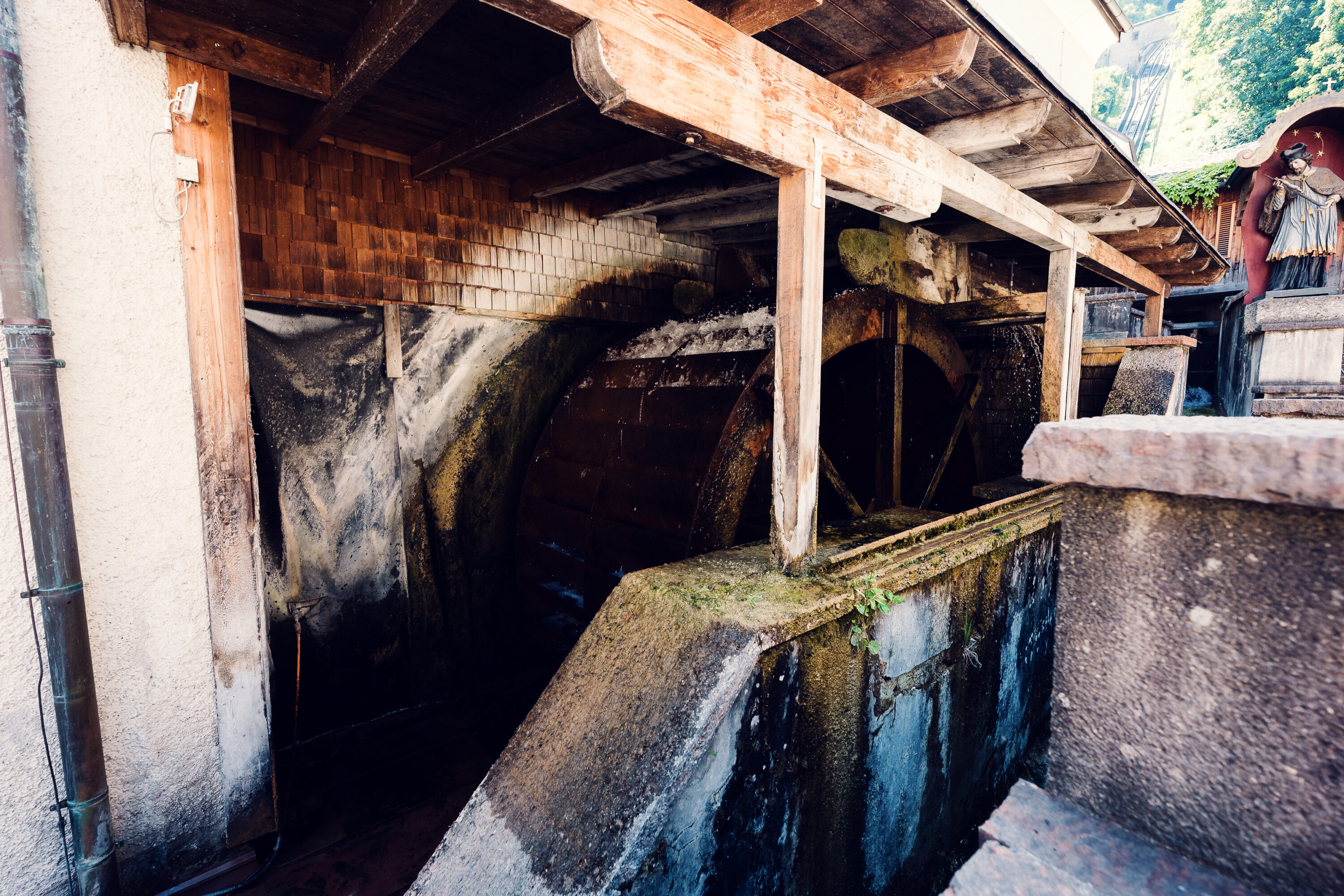
Historic waterwheel of the Stiftsbäckerei St. Peter under a wooden shingle roof, powered by the Almkanal.
The historic iron mill wheel of the Stiftsbäckerei St. Peter, still powered by the Almkanal.

For most of its history, the Stiftsbäckerei St. Peter received its flour from the Pfistermühle, a mill adjacent to the abbey. When that operation closed in 1966, the supply shifted to the Stifts- und Salzachmühle, another mill belonging to St. Peter's. In 2010, the Stiftsbäckerei St. Peter began grinding rye flour on site again, using a restored stone mill powered by the Almkanal. A small hydroelectric plant installed in 2006, driven by a rebuilt wooden waterwheel, generates around 90,000 kilowatt-hours per year - enough to power the mill and feed surplus electricity back into the grid.

The baking method at the Stiftsbäckerei St. Peter follows a centuries-old tradition. The bread is baked in a directly fired wood oven: wood is burned inside the baking chamber, the embers and ash are removed, and the loaves are placed where the fire has just heated the stone. Instead of modern convection baking, the method relies on the stored heat of the oven. Sourdough at the Stiftsbäckerei St. Peter is started the day before, left to develop its characteristic aroma overnight, then mixed the next morning with nothing but rye flour, water, and salt.

In late 2025, the longtime operators of the Stiftsbäckerei St. Peter - the Grabmer family, who had run it for 61 years - retired. Simon Dematté, a trained baker from the former Bio-Bäckerei Itzlinger, took over as the new tenant of the Stiftsbäckerei St. Peter, continuing the wood-fired tradition with abbey-owned wood, Almkanal energy, and the bakery's traditional directly fired oven.

Today, the Stiftsbäckerei St. Peter remains a rare Austrian bakery where the process from milling rye to baking the loaf can still be experienced under one roof. The Almkanal water system that powers the Stiftsbäckerei St. Peter has shaped this site since the Middle Ages.