
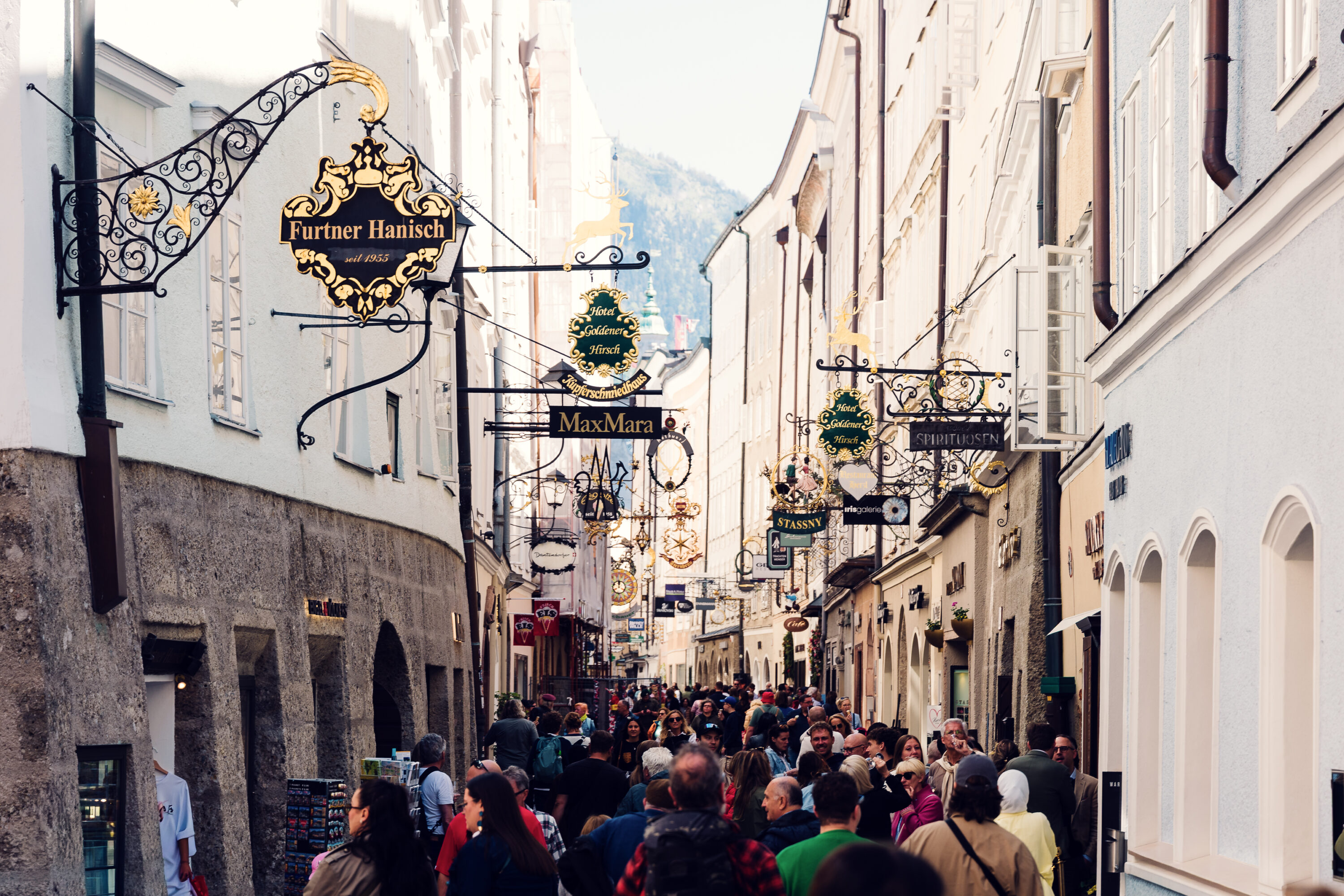
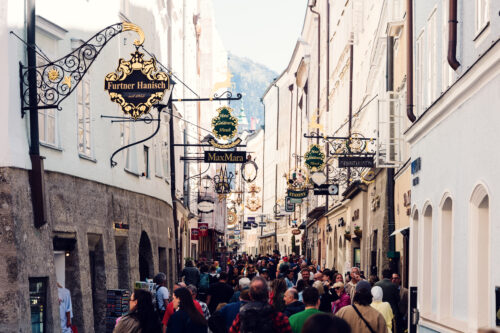
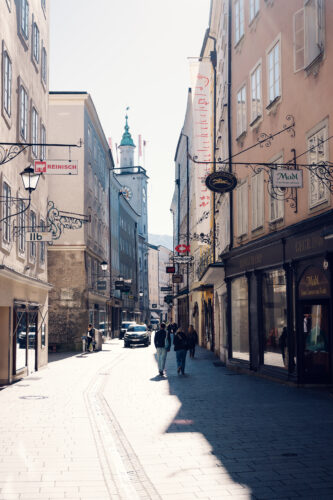
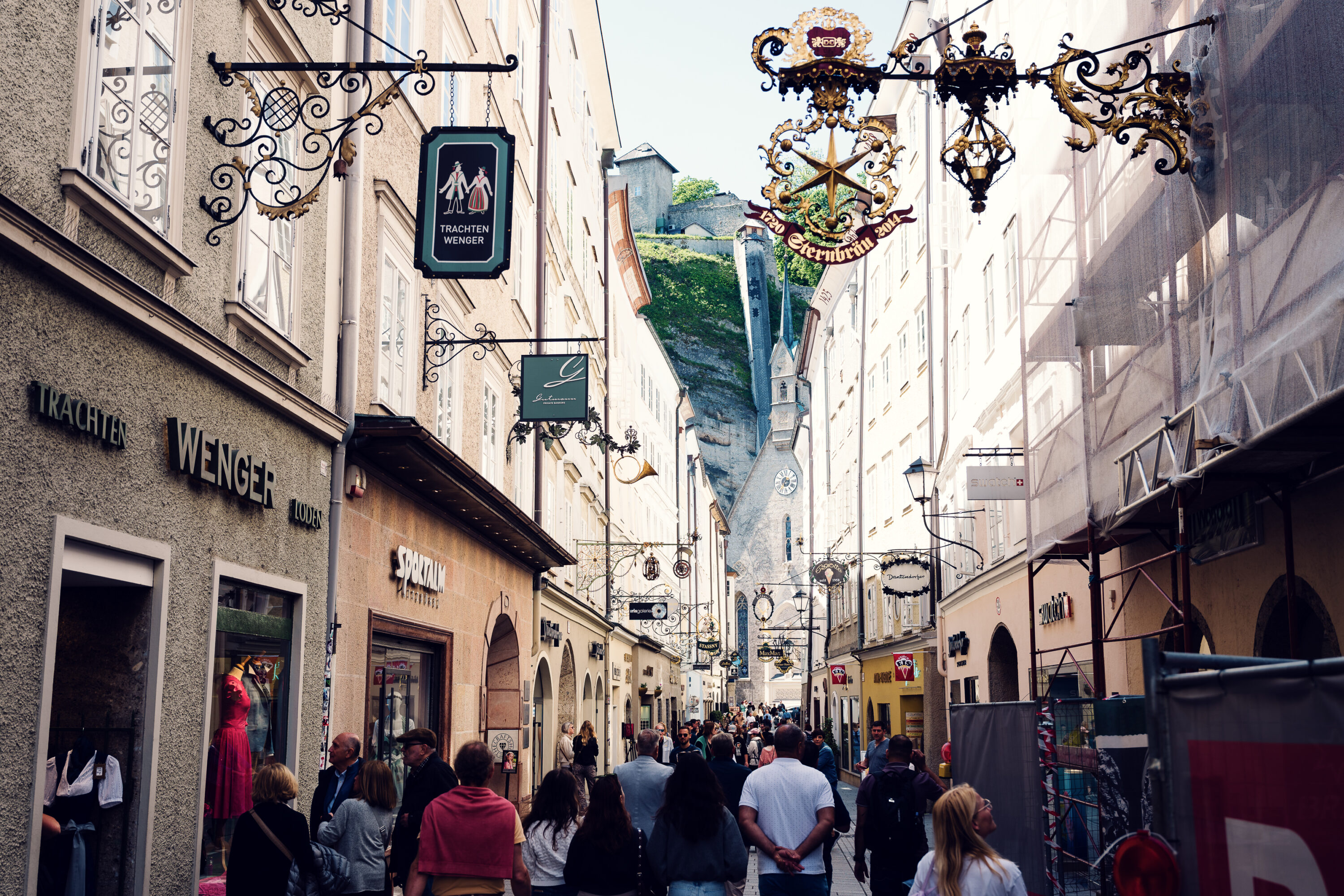
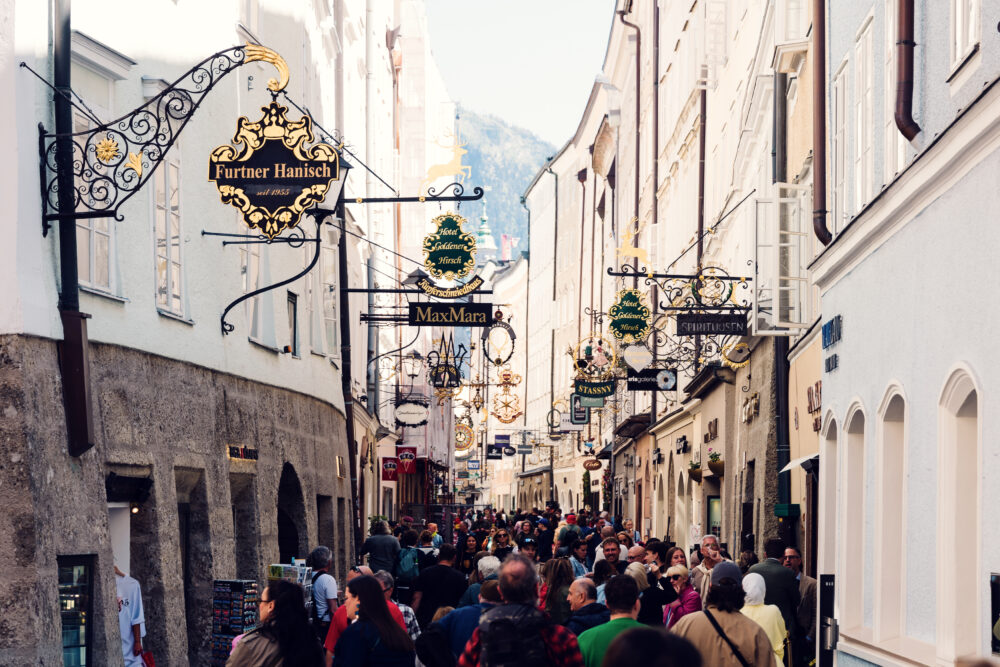
Crowds of visitors walking beneath the wrought iron guild signs on Getreidegasse.
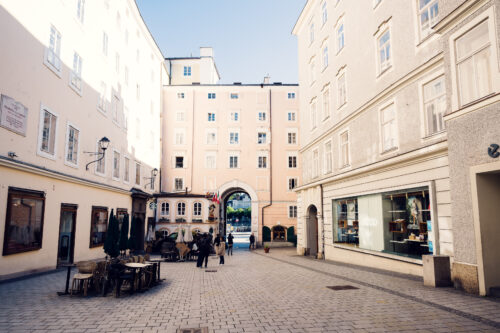
Colorful building facades and traditional shop signs along Getreidegasse in the early morning light.
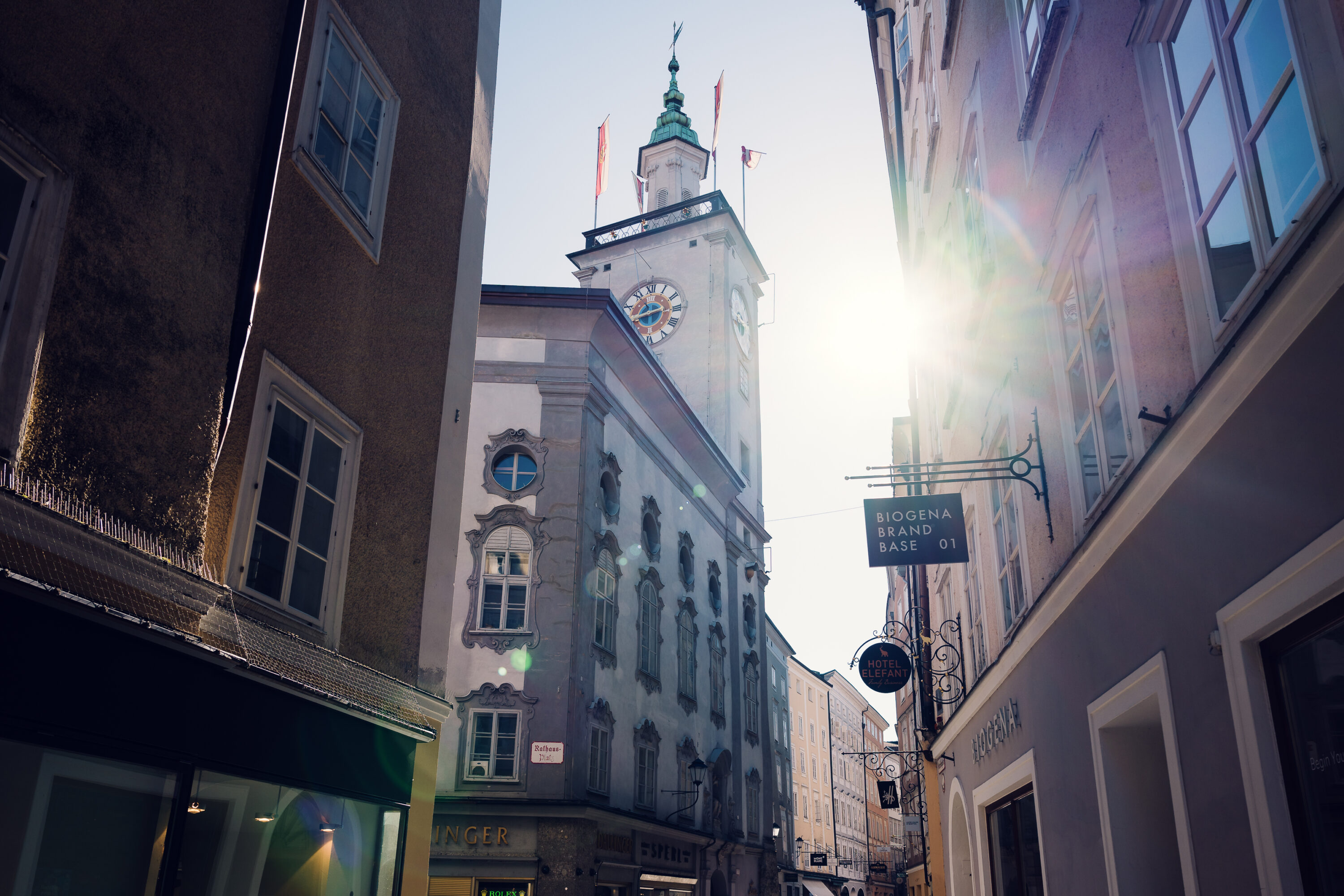
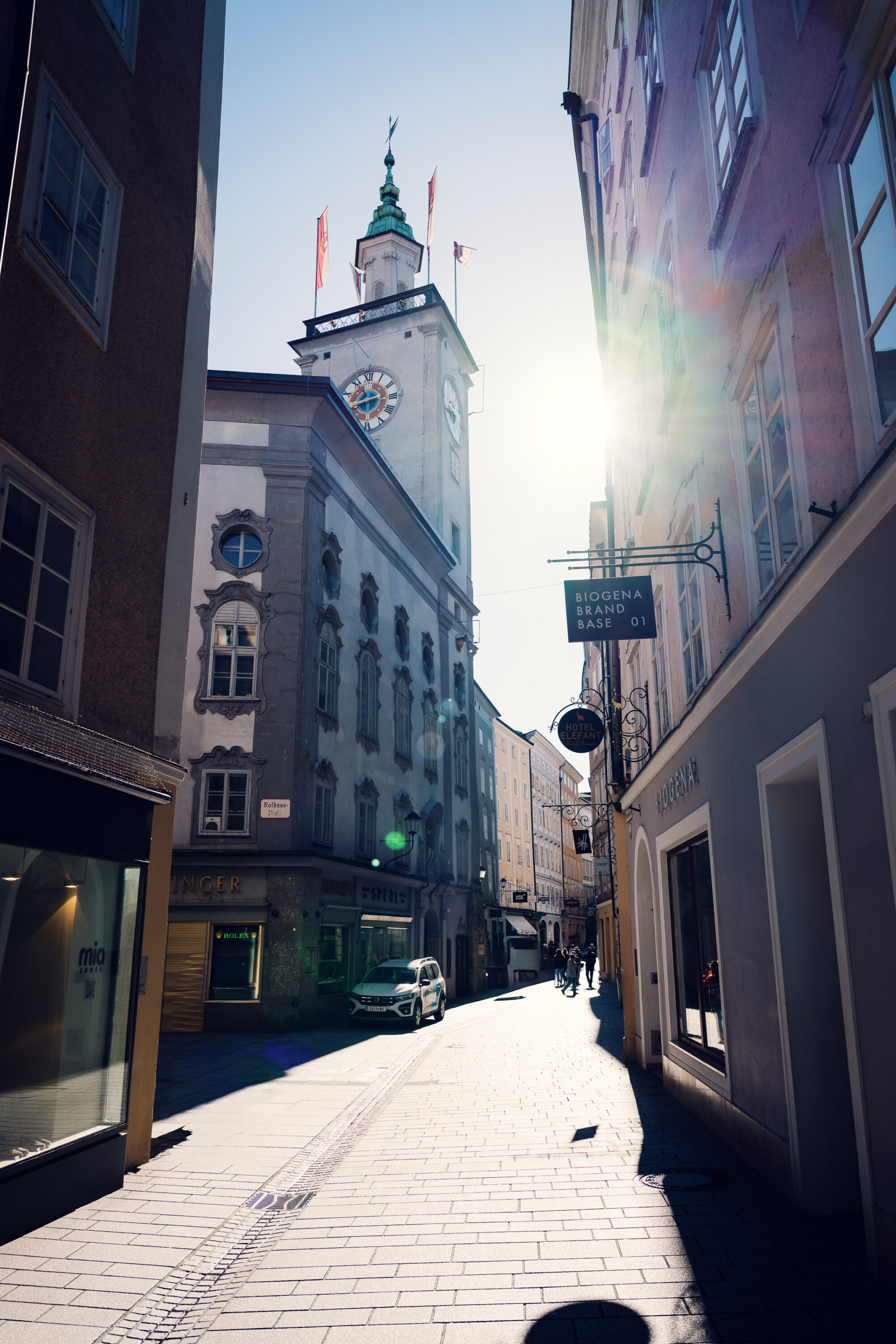
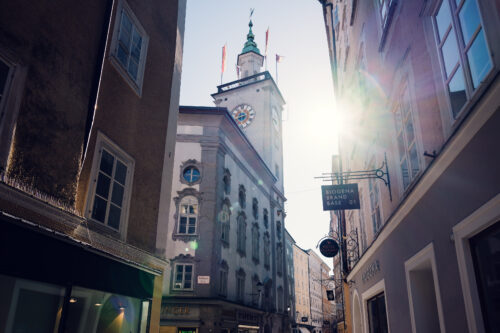
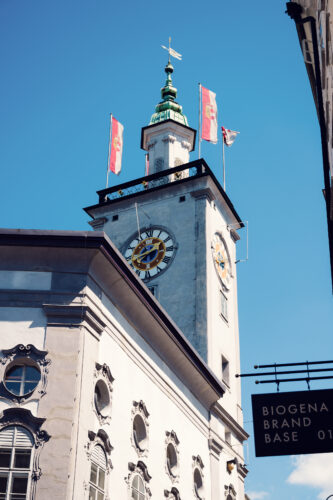
Looking up at the Rathaus tower from the narrow stretch of Getreidegasse.
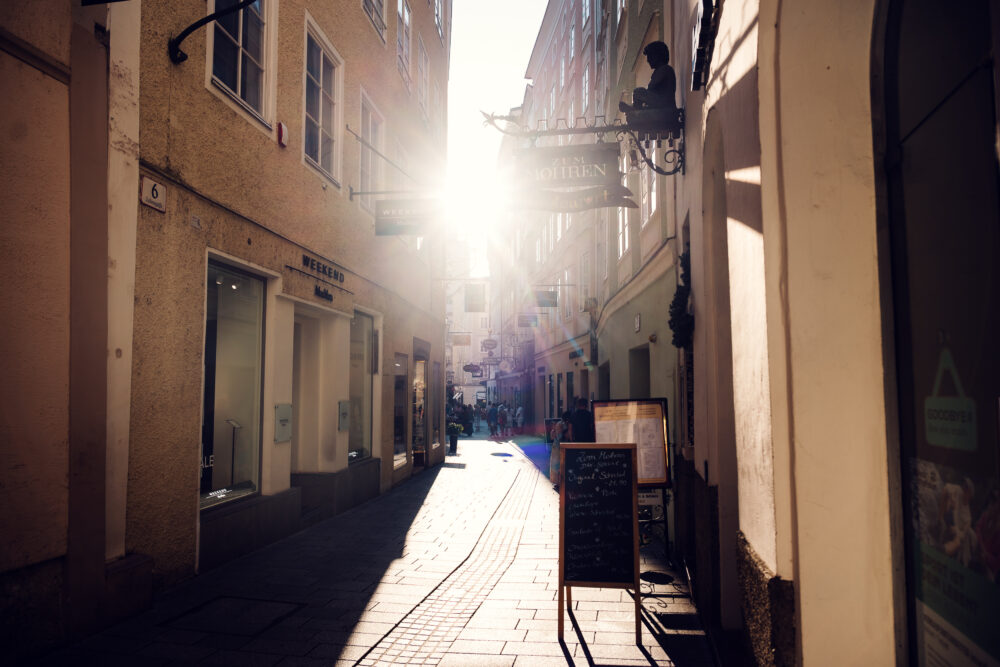
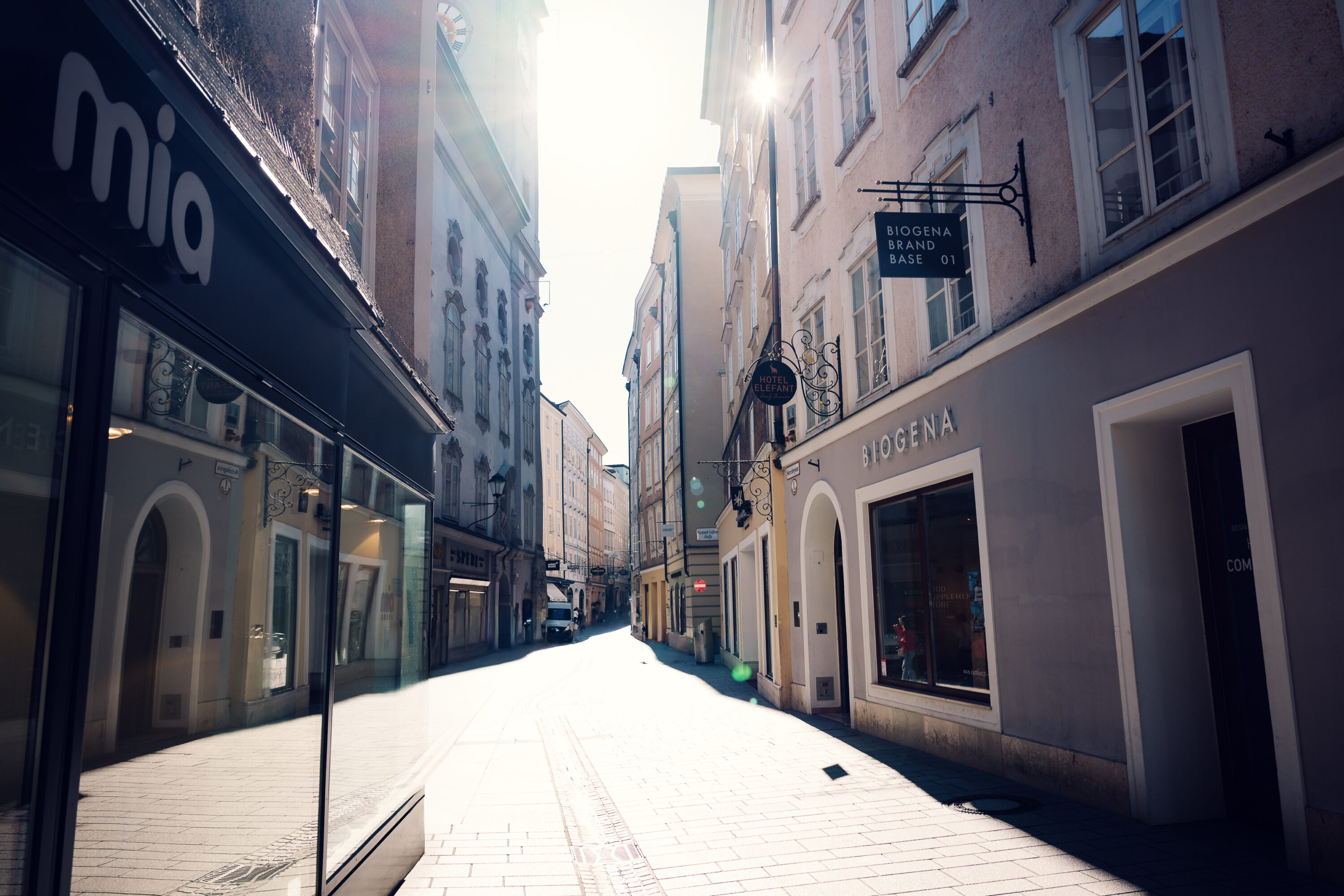
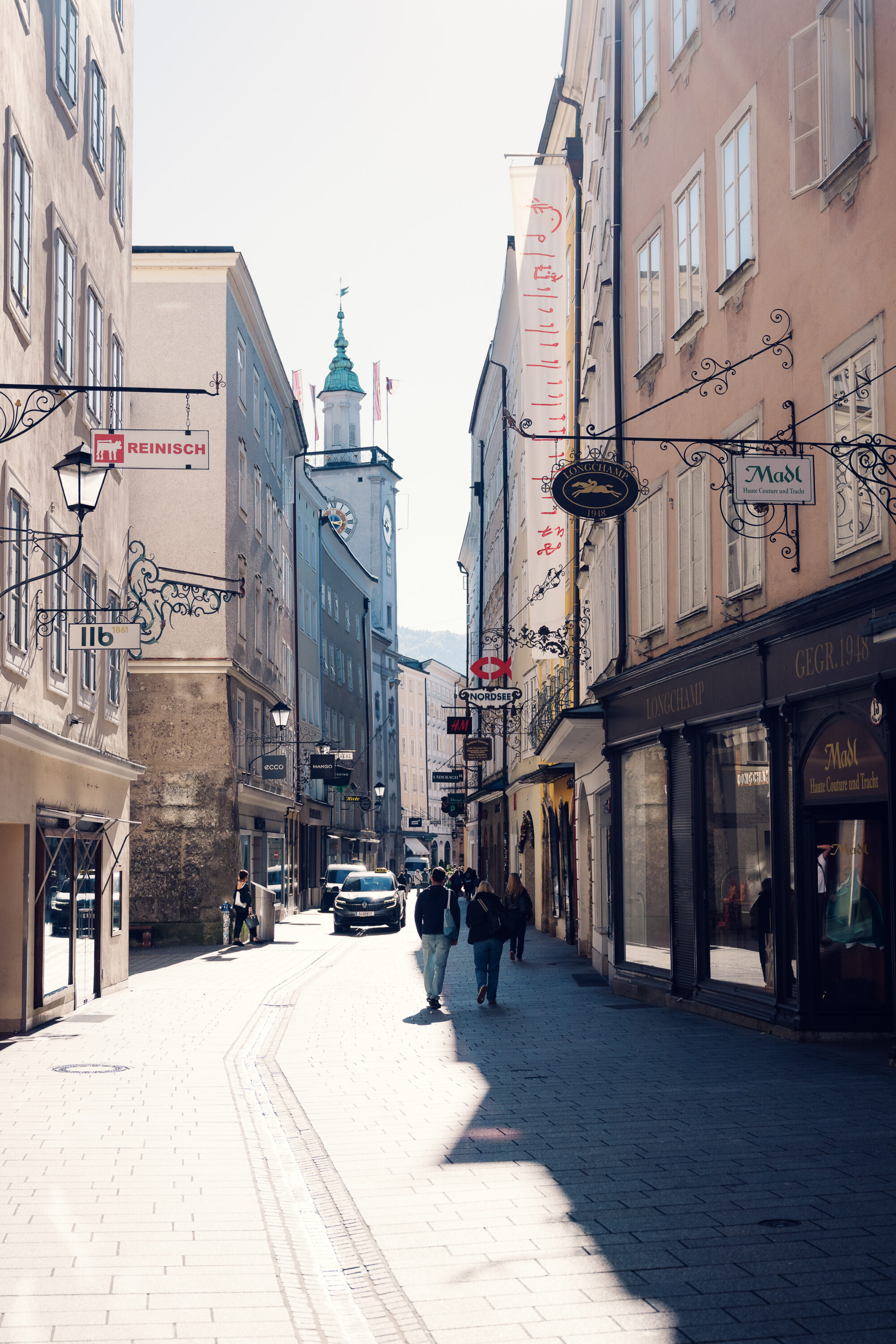
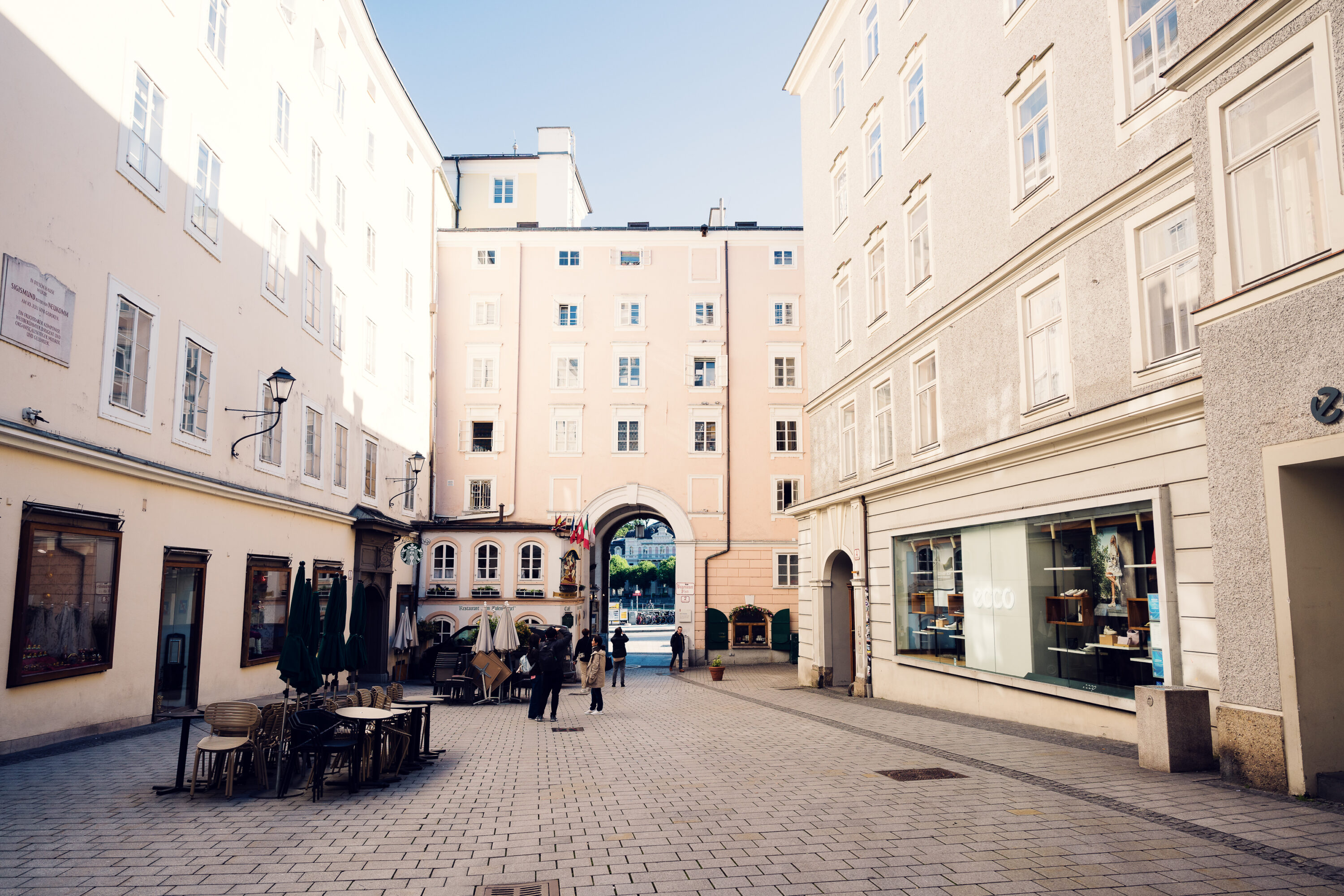
Morning sunlight on the empty cobblestone lane of Getreidegasse in Salzburg.
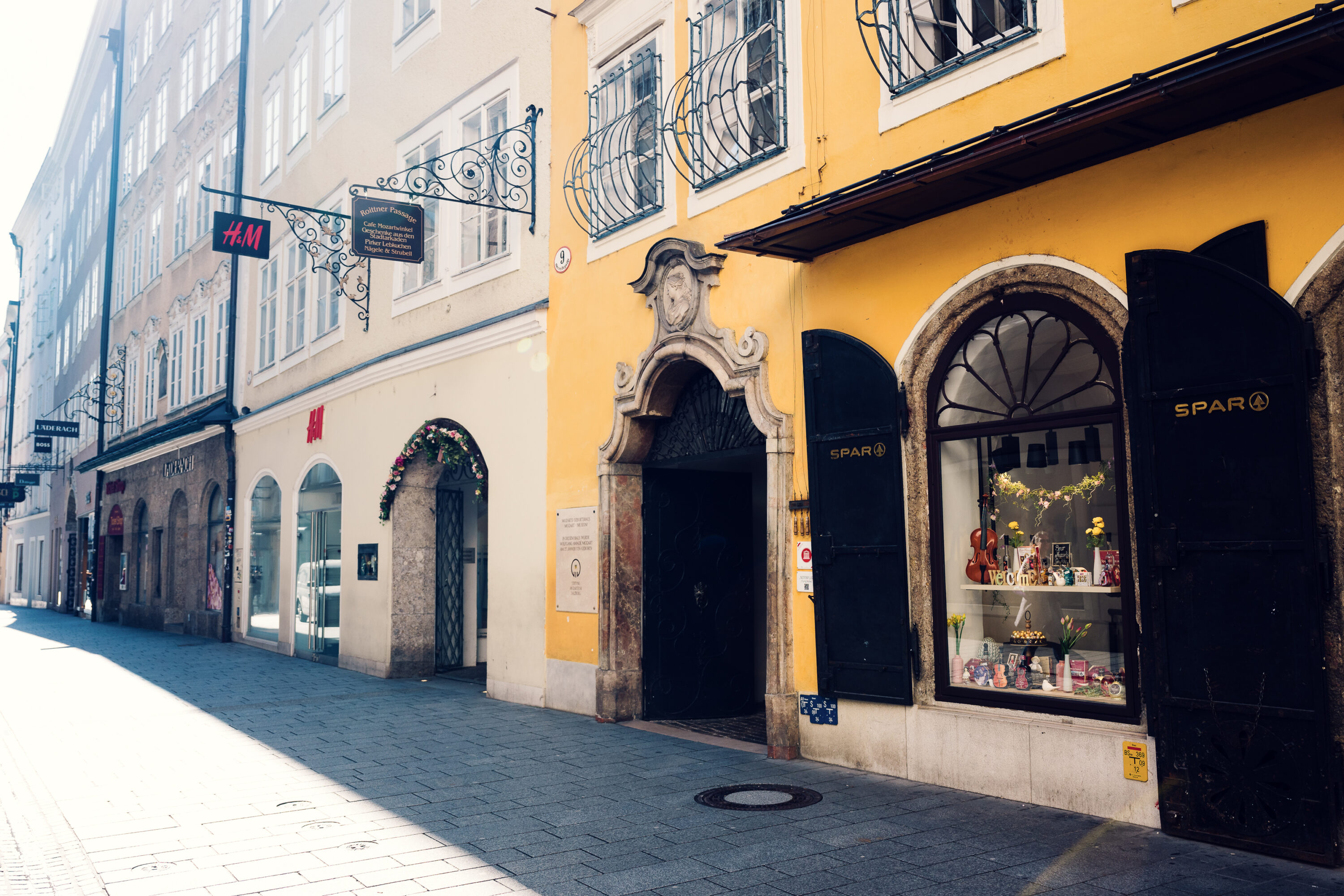
Ground-floor shops along Getreidegasse with wrought iron signs and arched storefronts.
Crowds of visitors walking beneath the wrought iron guild signs on Getreidegasse.
Salzburg Old Town Hall clock tower rising above Getreidegasse on a sunny day.
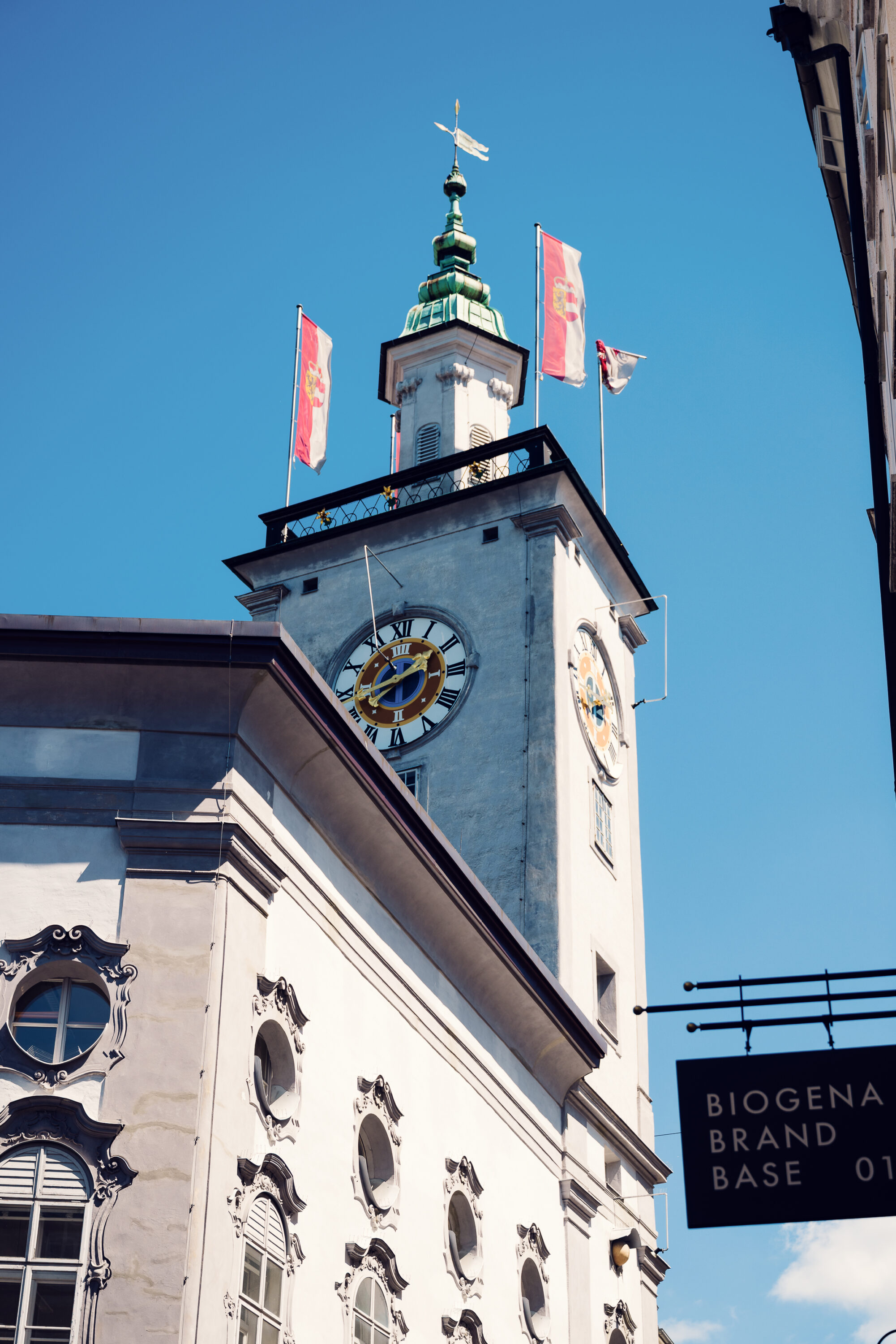
Close-up of the Salzburg Rathaus clock tower with flags against a clear blue sky.
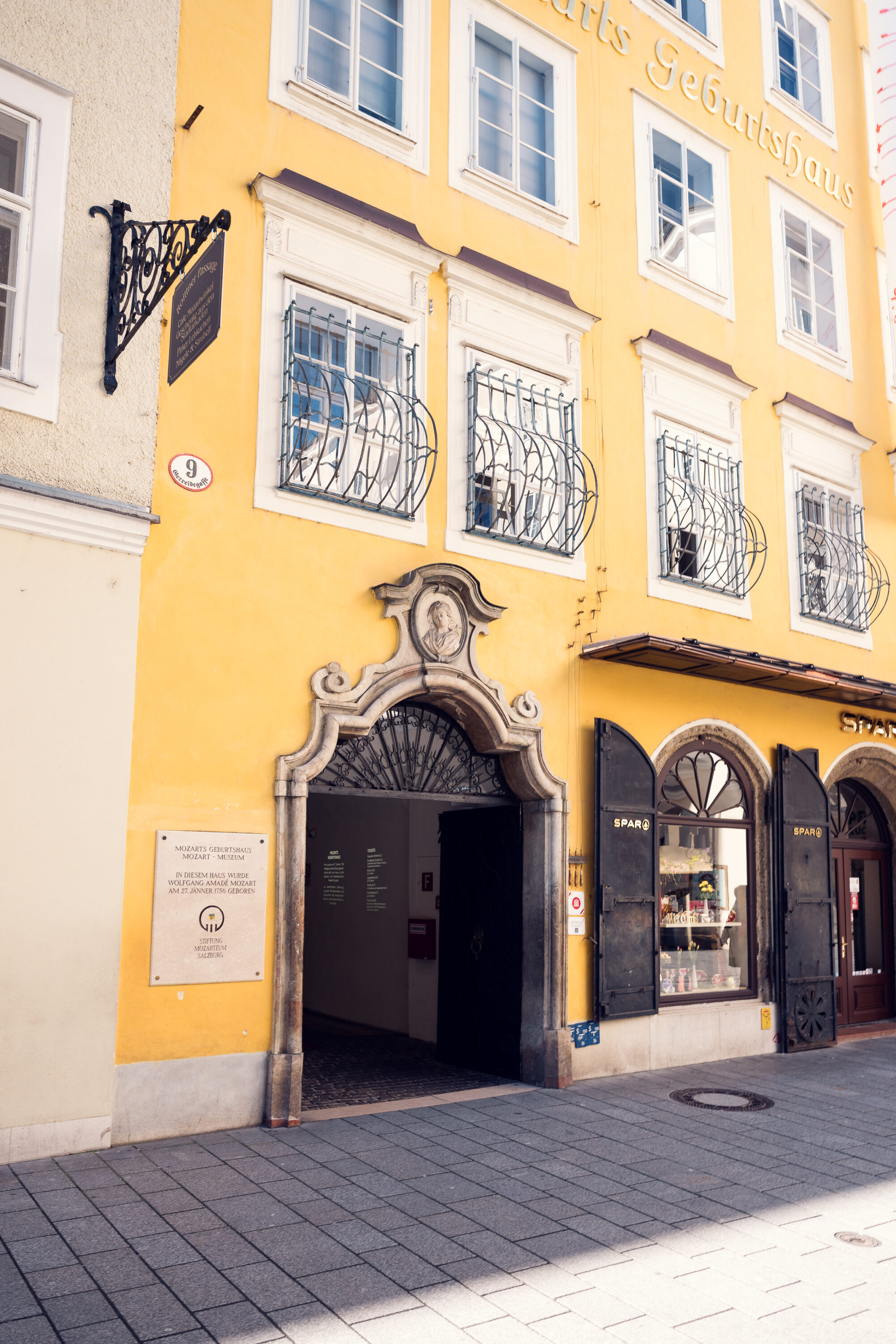
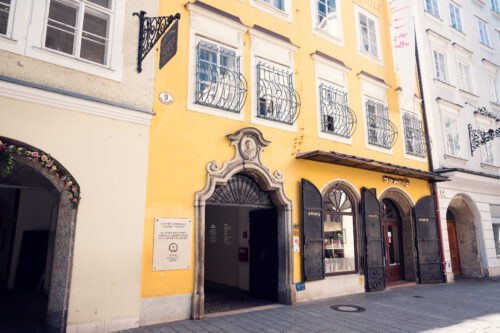
Full-height view of the Mozart's Birthplace building with the entrance portal and lettering above.
Wrought iron guild signs lining both sides of Getreidegasse with the Rathaus tower in the distance.
Fall in Love with

Getreidegasse

Salzburg's Getreidegasse is a medieval shopping street with wrought-iron guild signs, hidden passageways, Mozart's Birthplace, and traditional shops.

* Affiliate links: if you book, a small commission supports our independent work, at no extra cost to you.

01 / 05
01 / 05

Getreidegasse

Muvamo Must See 2026Picked by our team as one of Salzburg's essential sights.

2026

Must See

Getreidegasse

When a sight carries this label, it's one we'd send a friend to first. Must See is our highest distinction for sights, and our team gives it on the strength of our own visits, without fixed criteria or a set number of places. It can't be bought or applied for. The label shows the current year, and a sight that no longer holds up loses it.

See all Must See sights in Salzburg

Today
Always accessible
Admission
Free
Plan for
90 mins
outdoors
Where
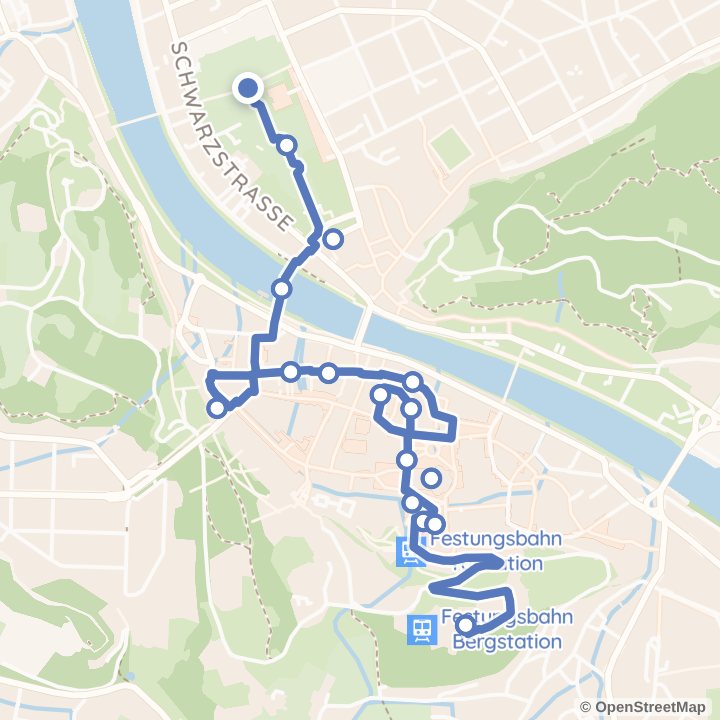
Old Town

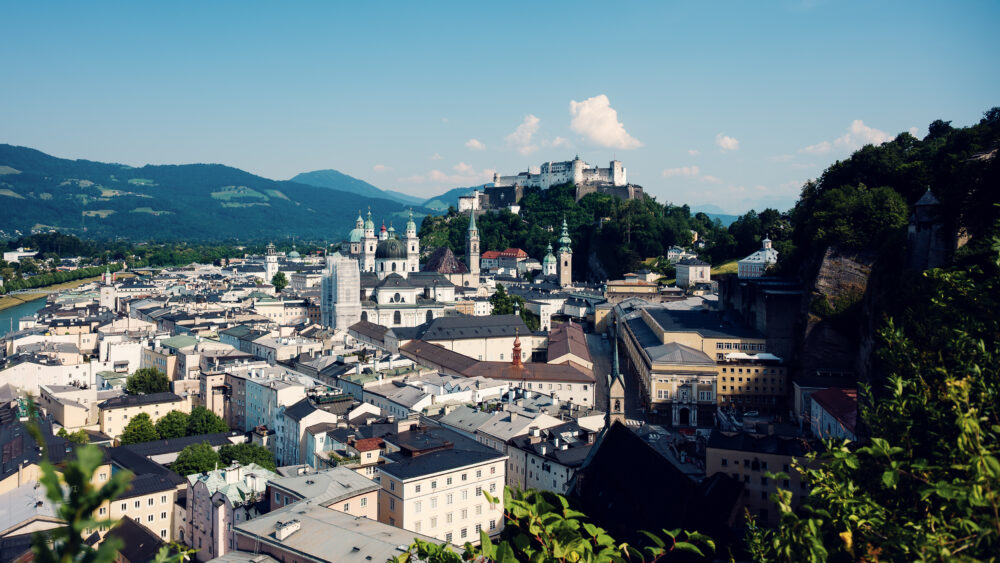
The Getreidegasse is Salzburg’s most famous historic street, running through the heart of the Old Town along a route that already existed in Roman times. First mentioned around 1150 as Trabegasse, it grew into one of the city’s most important trading streets and remains one of its defining urban spaces today.

Narrow historic houses, elegant portals, and the celebrated wrought-iron signs give the lane its unmistakable character. At No. 9, Mozart’s Birthplace draws visitors from around the world: Wolfgang Amadeus Mozart was born here in 1756, and his family remained in the house until 1773. Yet the Getreidegasse rewards looking beyond its most famous address. Historic Durchhäuser lead into inner courtyards and connecting passages, and the street’s mix of traditional Salzburg businesses and contemporary retail keeps it rooted in everyday city life rather than frozen as a monument. Set within Salzburg’s UNESCO-listed Historic Centre and the pedestrianized Old Town, it is one of the city’s essential places to explore on foot.

Plan your visit

Opening Hours
Always accessible
Getting there
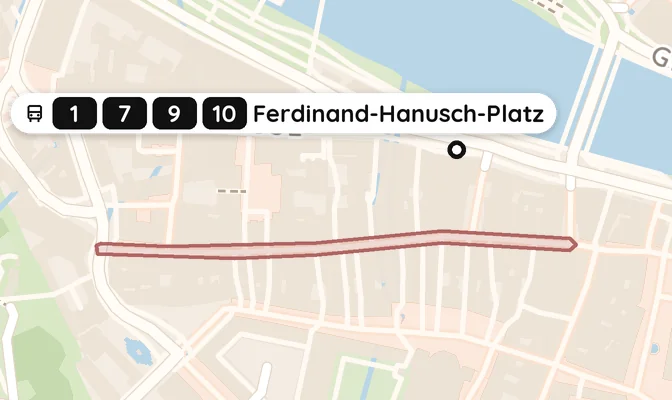
Getreidegasse, 5020 SalzburgBus 1 7 9 10 Ferdinand-Hanusch-Platz · 2 min walkOld Town

What's on here

Sternadvent and Winter Market

A small Christmas market in the Sternarkaden, the arcaded courtyard of the old Sternbräu brewery inn between Getreidegasse and Griesgasse. Craft stalls where you meet the makers, carols, and a slower pace.

Nov 19, 2026 - Jan 06, 2027

Sternadvent and Winter Market

Nov 19, 2026 - Jan 06, 2027

A small Christmas market in the Sternarkaden, the arcaded courtyard of the old Sternbräu brewery inn between Getreidegasse and Griesgasse. Craft stalls where you meet the makers, carols, and a slower pace.

  • Sternarkaden, Getreidegasse 34 / Griesgasse 23, 5020 Salzburg
  • Sun-Thu 11:00-19:00, Fri-Sat 11:00-20:30. 24 and 31 Dec 10:00-15:00, 1-6 Jan daily 11:00-18:00.
  • The arcades run right through the block, so you can step in from Getreidegasse and come out on Griesgasse, by the Hanuschplatz bus stop. If you're in Salzburg after New Year, keep this one in mind: it carries on as a winter market until Epiphany on 6 January.

Krampus and Perchten Runs in Salzburg

Hand-carved wooden masks, shaggy fur and heavy bells: on Advent evenings, Krampus and Perchten groups stamp and roar their way through the old town to drive out the winter.

Dec 05, 2026 - Dec 21, 2026

Krampus and Perchten Runs in Salzburg

Dec 05, 2026 - Dec 21, 2026

Hand-carved wooden masks, shaggy fur and heavy bells: on Advent evenings, Krampus and Perchten groups stamp and roar their way through the old town to drive out the winter.

  • Salzburg old town: Christmas market on Domplatz, Getreidegasse, Alter Markt and Linzergasse; plus Maxglan, from Rochusgasse to Stiegl-Brauwelt, 5020 Salzburg
  • Sat 5 December: Barmstoana run in Linzergasse from 17:00, Falkenpass run through Getreidegasse and Alter Markt from 17:30, Krampus run at the Christmas market on Domplatz around 19:00. Sun 6 December: St Nicholas and the children's Krampus at the Christmas market from 15:30. Tue 8 December: Maxglan Krampus and Perchten run from 18:00. Mon 21 December: Perchten run at the Christmas market on Domplatz around 19:00.
  • For the Falkenpass run, wait on the Alter Markt: the route loops from the Festspielhaus through the Getreidegasse. With small children, watch from a few steps back, because the Krampuses carry chains and switches. The gentler version is St Nicholas with his children's Krampus at the Christmas market on the afternoon of St Nicholas Day.

Jazz & The City

~Oct 15, 2027 - Oct 18, 2027 Estimated

Four days when Salzburg's old town turns into a free, open-ended stage. Jazz and improvised music spill out of churches, courtyards, bars and hotel lobbies, no ticket required.

  • Various venues across the historic old town, 5020 Salzburg
  • Set times across venues throughout the old town, with a pre-opening the evening before the festival starts.
  • Free Entry
  • There's no fixed seating and no entry fee, so the trick is to wander. Grab the programme, then drift between venues and let the city's acoustics do the rest.

Stadtfest Salzburg

Jun 23, 2028 - Jun 25, 2028

A city festival that takes over the old town for a June weekend. Stages on every square, street food, sport and a light-and-fire show on the Salzach after dark.

  • Altstadt squares and bridges, 5020 Salzburg
  • Programme across the old town from Friday afternoon through Sunday.
  • Free Entry
  • The Saturday-night fire and light show on the Salzach is the highlight; grab a spot on one of the bridges before dusk. The centre is closed to traffic, so come on foot or by bus.

Tours & experiences

Getreidegasse


Muvamo Opinion

The Getreidegasse can get busy, especially near Mozart’s Birthplace, but it rewards looking beyond the shop windows. Above the street, the ornate wrought-iron guild signs are one of its most distinctive features, and the traditional Wieber locksmith’s shop on the Getreidegasse still produces these signs by hand. The tradition goes back to the Middle Ages, when visual symbols helped identify trades and workshops.

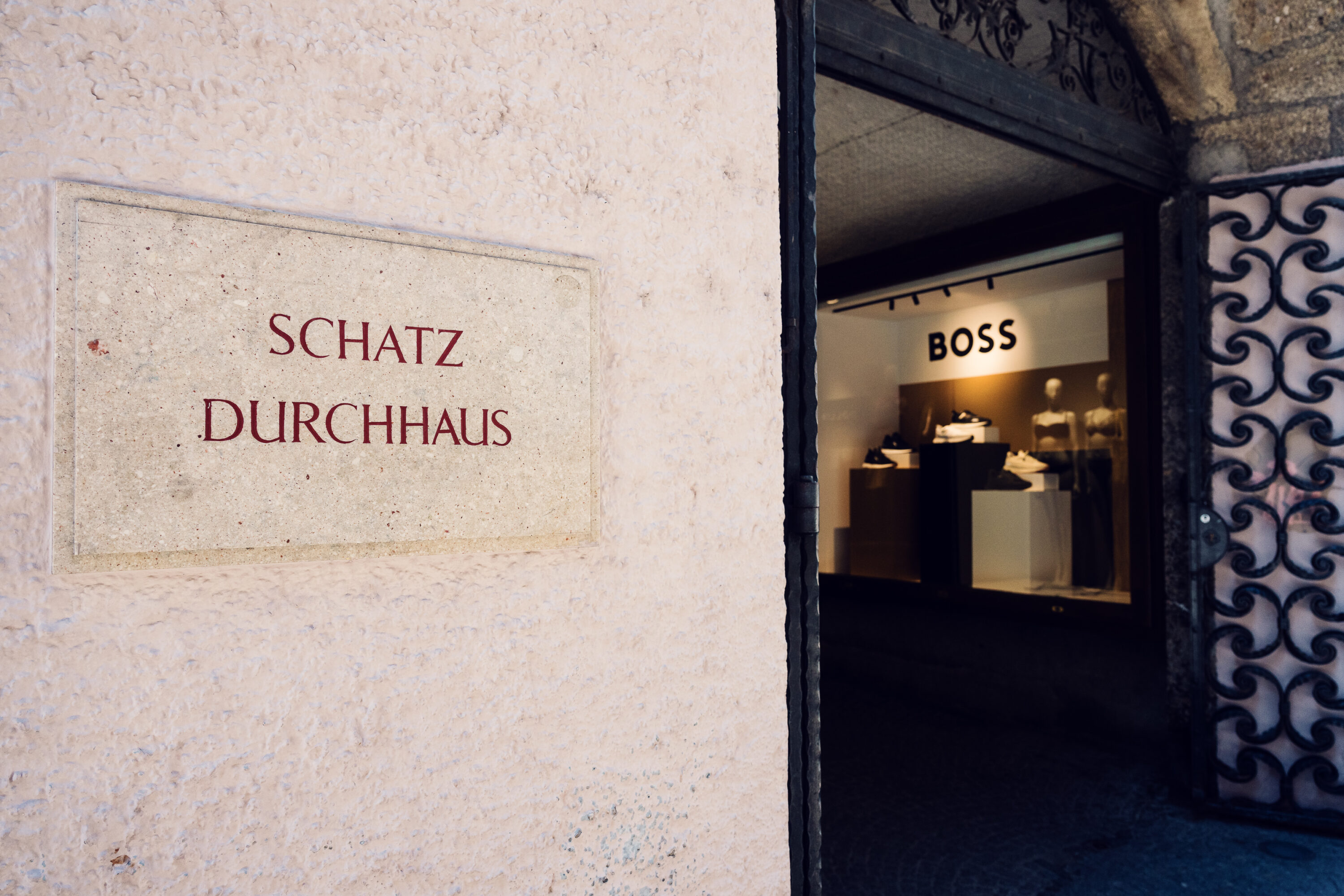
Another hallmark of the street is its network of Durchhäuser - passageways that run through the historic buildings and connect the Getreidegasse with side streets, courtyards, galleries, and Universitätsplatz. The best-known is the Schatz House at No. 3 Getreidegasse, whose passage to University Square includes a relief of the Madonna with the infant Jesus in a dark niche.

The architecture has its own details worth noticing as well. Many houses feature beautiful portals, while the windows become steadily smaller from the first floor upward. The facades are often decorated with historical dates, the names of former owners, and even the Eye of God.

Together with its mix of traditional businesses and international brands, these features make the Getreidegasse feel like far more than a shopping street - it is one of the defining streets of Salzburg’s Old Town.

Recommended tours & experiences

Helpful Hints

Gastronomic Discoveries

  • Café Fürst at the corner of Brodgasse is where the original Mozartkugel was invented in 1890. The handmade version here is noticeably different from the mass-produced kind.
  • For a proper sit-down meal after exploring the street, the Restaurant Stiegl Keller is a short walk up the Festungsgasse. Traditional Austrian dishes, fresh Stiegl beer from the barrel, and a terrace with Old Town views.

Hidden Gems

  • Look for the painted "Eye of God" symbols, historical dates, and former owners' names on the building facades - most visitors walk right past them focused on the shop windows.

Our Little Extras

  • The Getreidegasse continues into the Judengasse, while the Linzergasse begins across the Salzach on the right bank of the Old Town. Walking all three gives you a good sense of how Salzburg’s historic commercial streets developed on both sides of the river.
Photo Spots & POIs
Crowds of visitors walking beneath the wrought iron guild signs on Getreidegasse.

Guild Signs Corridor

The hand-forged guild and trade signs are the Getreidegasse's most recognizable feature. Every shop displays one, from golden pretzels for bakeries to serpents for pharmacies. The tradition dates back to the Middle Ages, when most people couldn't read and relied on visual symbols. The Wieber locksmith workshop at No. 28 has been producing these signs by hand since 1415 and continues to do so today.

Map
Photos
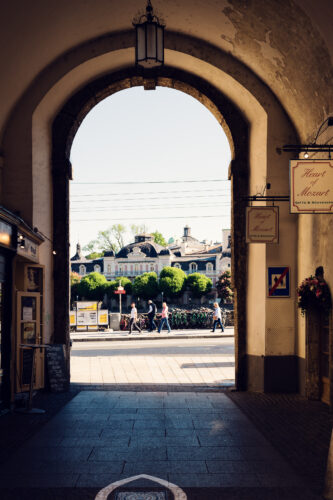
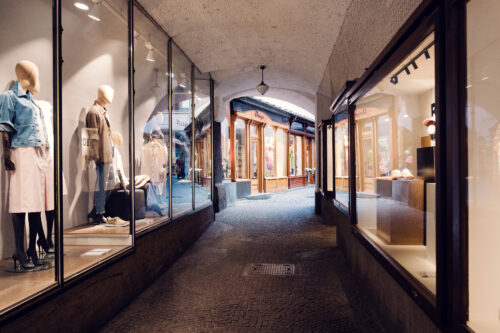
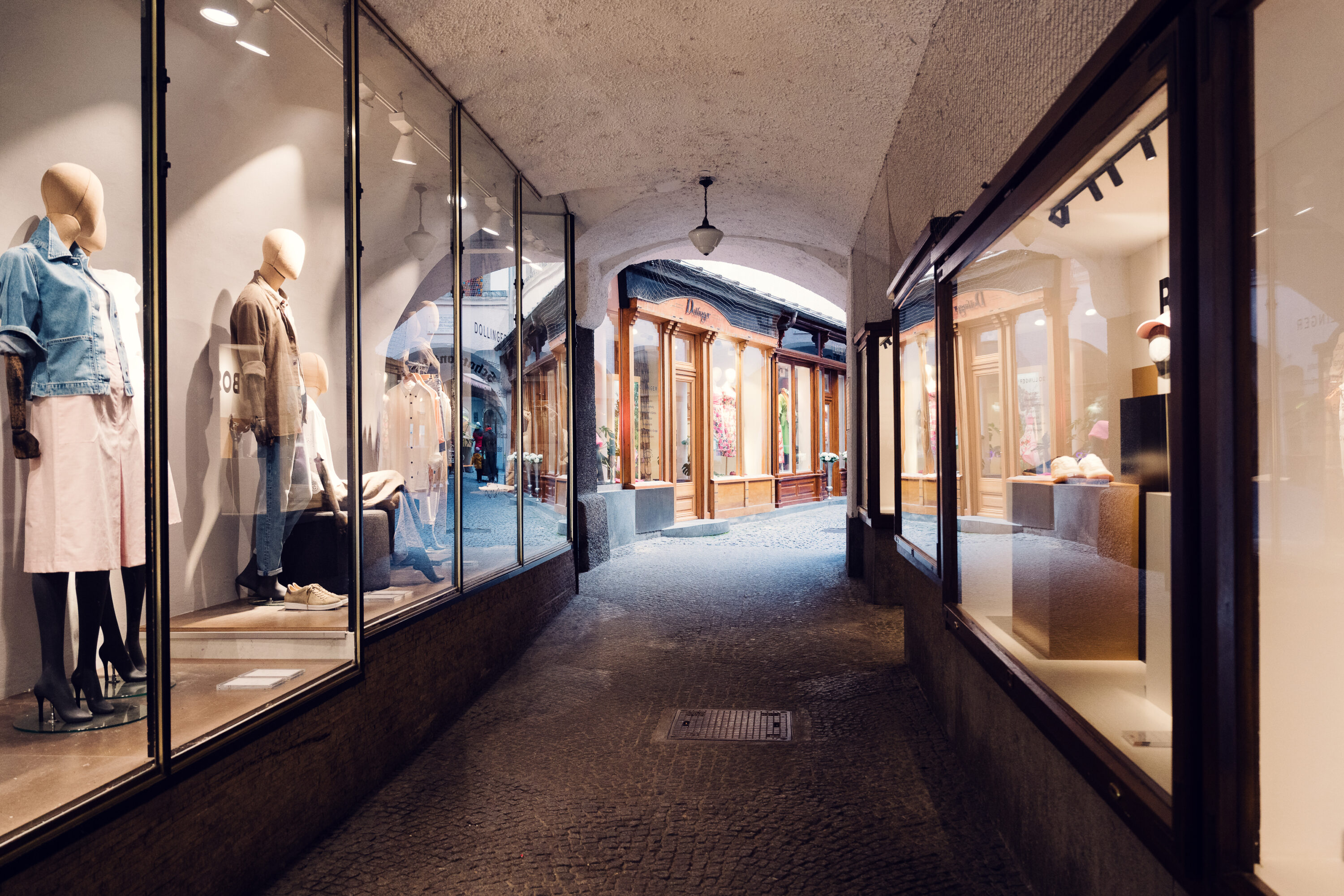
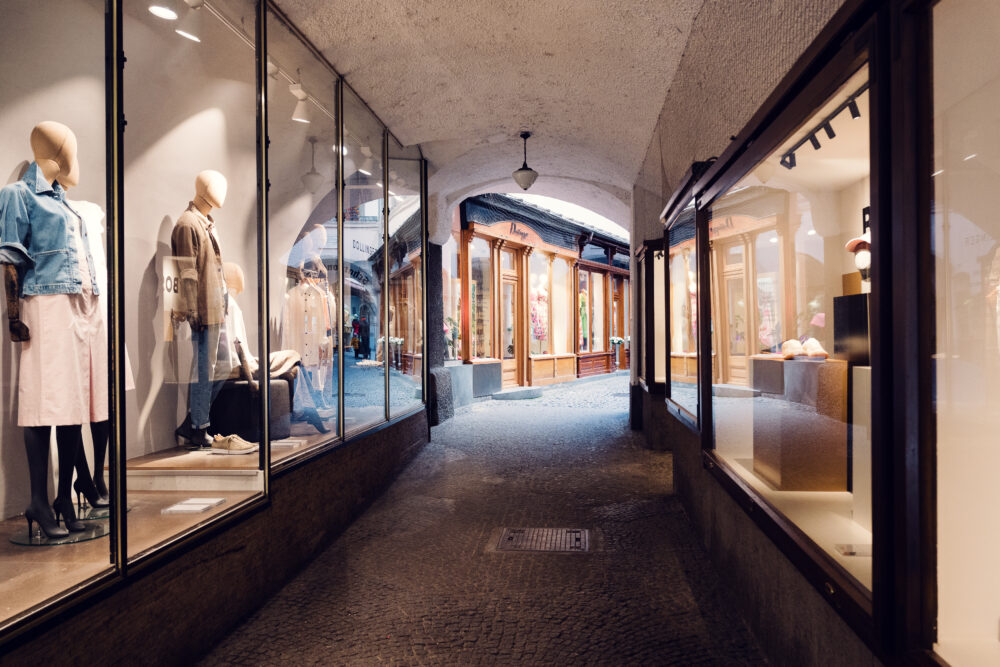
Vaulted passage of the Schatz Durchhaus with shop windows and fashion displays on both sides.

Durchhaus Courtyards

The Durchhäuser are public passageways running through private buildings. The odd-numbered ones connect the Getreidegasse to Universitätsplatz, while the even-numbered ones lead toward the Salzach. In medieval times, they channeled water from the Almkanal through the street for cleaning every Saturday. Today they're lined with small shops and galleries, with stone arches, vaulted ceilings, and flower-filled courtyards. The Schatz-Haus at No. 3 is the most notable: inside the passage, a whale rib and a dried shark hang from the ceiling, recalling the far-reaching Levant trade of the Mayr merchant family who once operated here.

Map
Photos
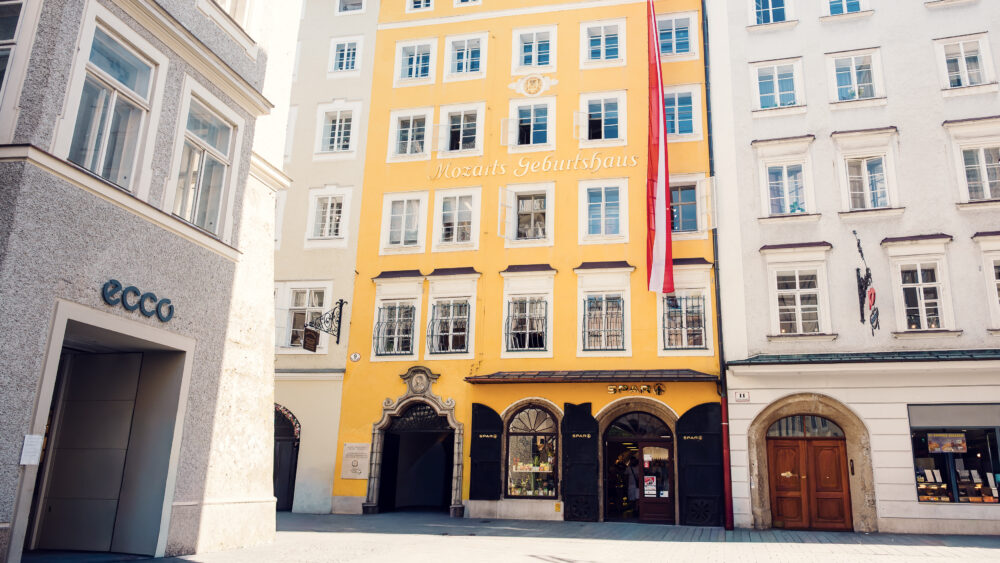
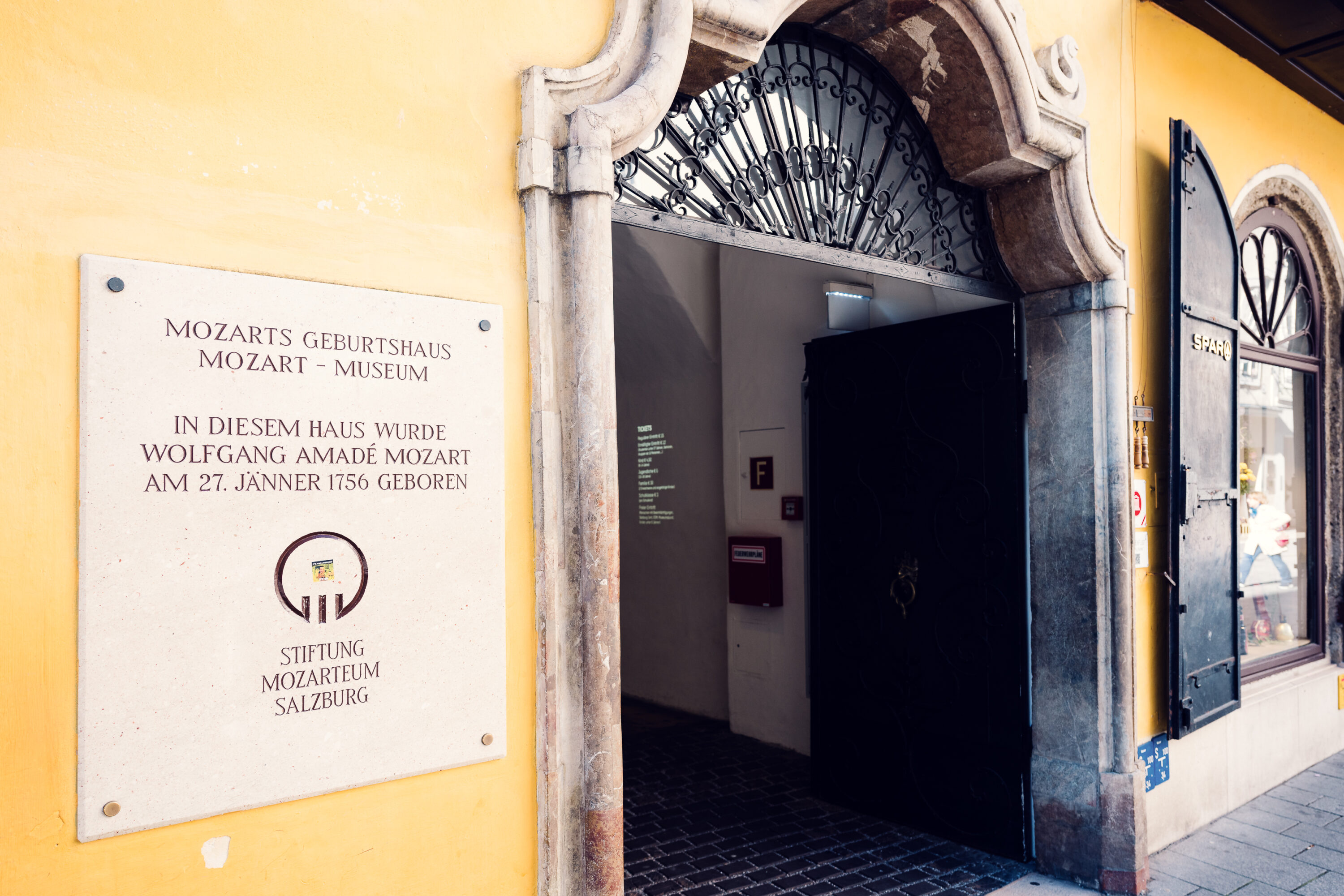
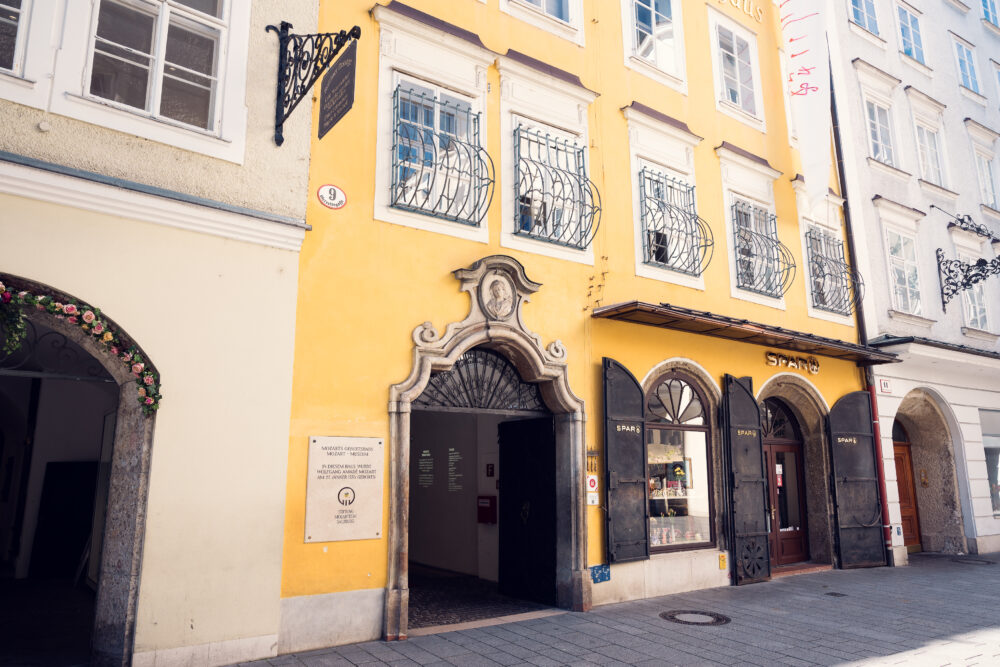
Yellow facade of Mozart's Birthplace at Getreidegasse 9 with wrought iron window grilles.

Mozart's Birthplace Facade

The bright yellow building at No. 9 is where Wolfgang Amadeus Mozart was born on January 27, 1756. The family lived here for 17 years before moving to the Tanzmeisterhaus on Makartplatz in 1773. Today, the three floors house a museum with original instruments, letters, portraits, and period rooms. It's the single most visited spot on the Getreidegasse and typically draws crowds from mid-morning onward.

Map
Photos More

From Roman Trade Route to Salzburg's Golden Mile – Getreidegasse

The Getreidegasse has been a central artery of Salzburg life for many centuries. During the Roman period, when Salzburg was still known as Iuvavum, this route was already an important road through the settlement toward Bavaria. Over time, it developed into one of the city’s key thoroughfares, which meant that trade, travel, and everyday movement regularly passed through this part of Salzburg.

The street's first documented mention dates to around 1150, when it appeared in records as "Trabegasse" - derived from the verb "traben" (“to trot”), likely a reference to the horse traffic along the route. Despite what the current name suggests, "Getreidegasse" has nothing to do with grain ("Getreide" in German). The name evolved through several variations over the centuries before settling on its present form.
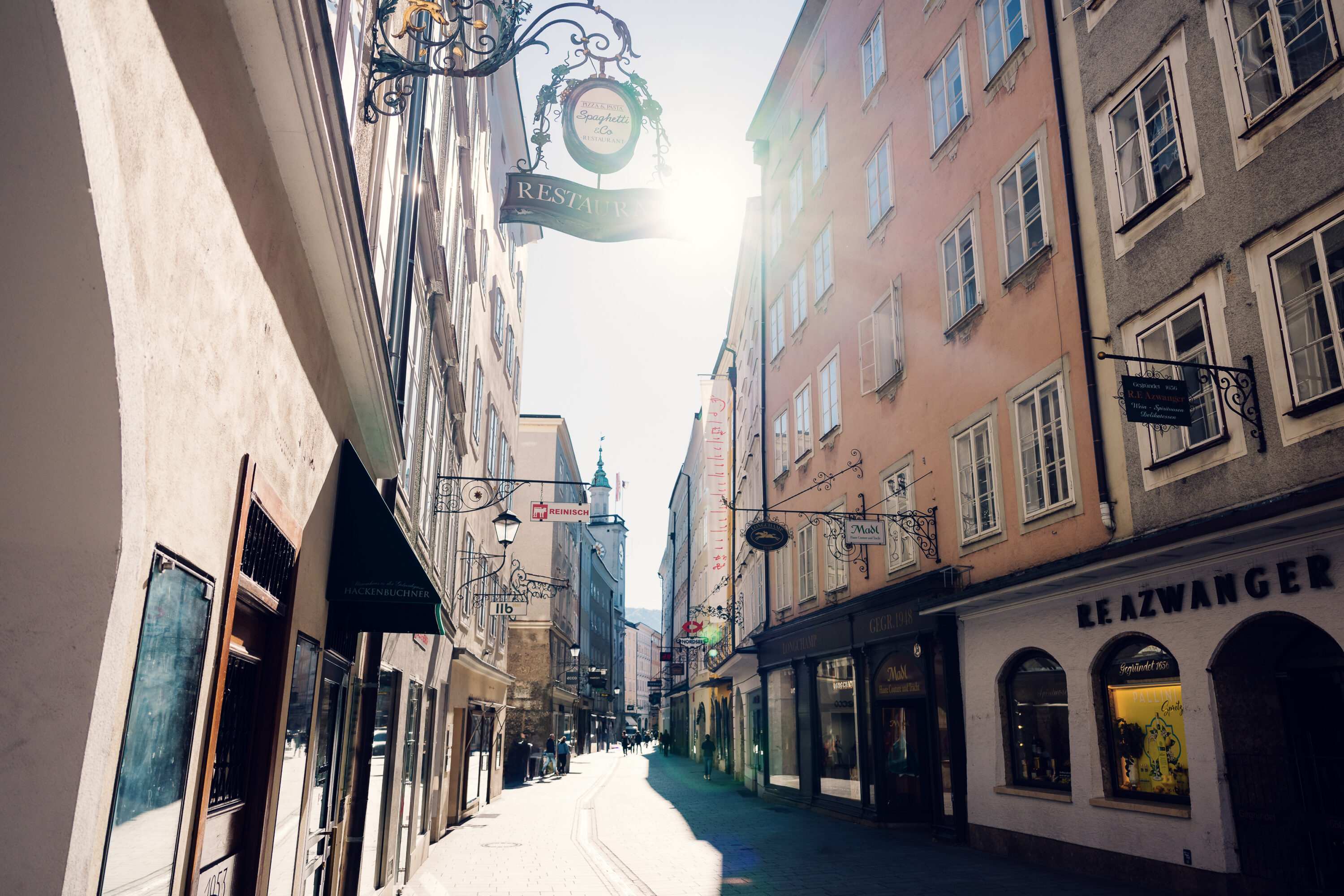
Colorful building facades and traditional shop signs along Getreidegasse in the early morning light.
Getreidegasse in Salzburg's Old Town, one of the most famous shopping streets in Europe.

Merchants, Minters, and the Rise of a Golden Address

By the 14th century, the prince-archbishops of Salzburg had granted the street's citizens staple rights, which required passing traders to display their goods for local sale. This helped transform the Getreidegasse into a commercial hub. The tall, narrow townhouses that line the street today belonged to many of the city's wealthiest residents, including councilmen, judges, officials, and minters. Trading houses, apothecaries, breweries, and craft workshops made this stretch one of the commercial hearts of the city.

The buildings themselves are a striking example of practical medieval urban architecture. Built narrow and deep, they rose upward rather than outward. Many feature ornate stone doorways on the ground floor and windows that shrink in size with each ascending story - one of the street’s characteristic architectural features. Saturday mornings, and also before holidays, the entire street was flushed clean by diverting water from the Almkanal, an impressively organized sanitation system for its time.

Mozart's Birthplace and the Street's Most Famous Address

The house at No. 9 Getreidegasse is one of the most famous residential addresses in Austria. Known as the Hagenauerhaus after the merchant family who owned it, the building was home to Leopold and Anna Maria Mozart from 1747. Their son Wolfgang Amadeus Mozart was born here on January 27, 1756 - the seventh child, though only the second to survive infancy. The family occupied a third-floor apartment and remained here until moving to the Tanzmeisterhaus on the other side of the river, now Makartplatz, in 1773.

The International Mozarteum Foundation opened a museum in the building in 1880. Visitors can see original documents, portraits, historical instruments, original rooms, and reconstructed domestic spaces connected with Mozart’s early life.
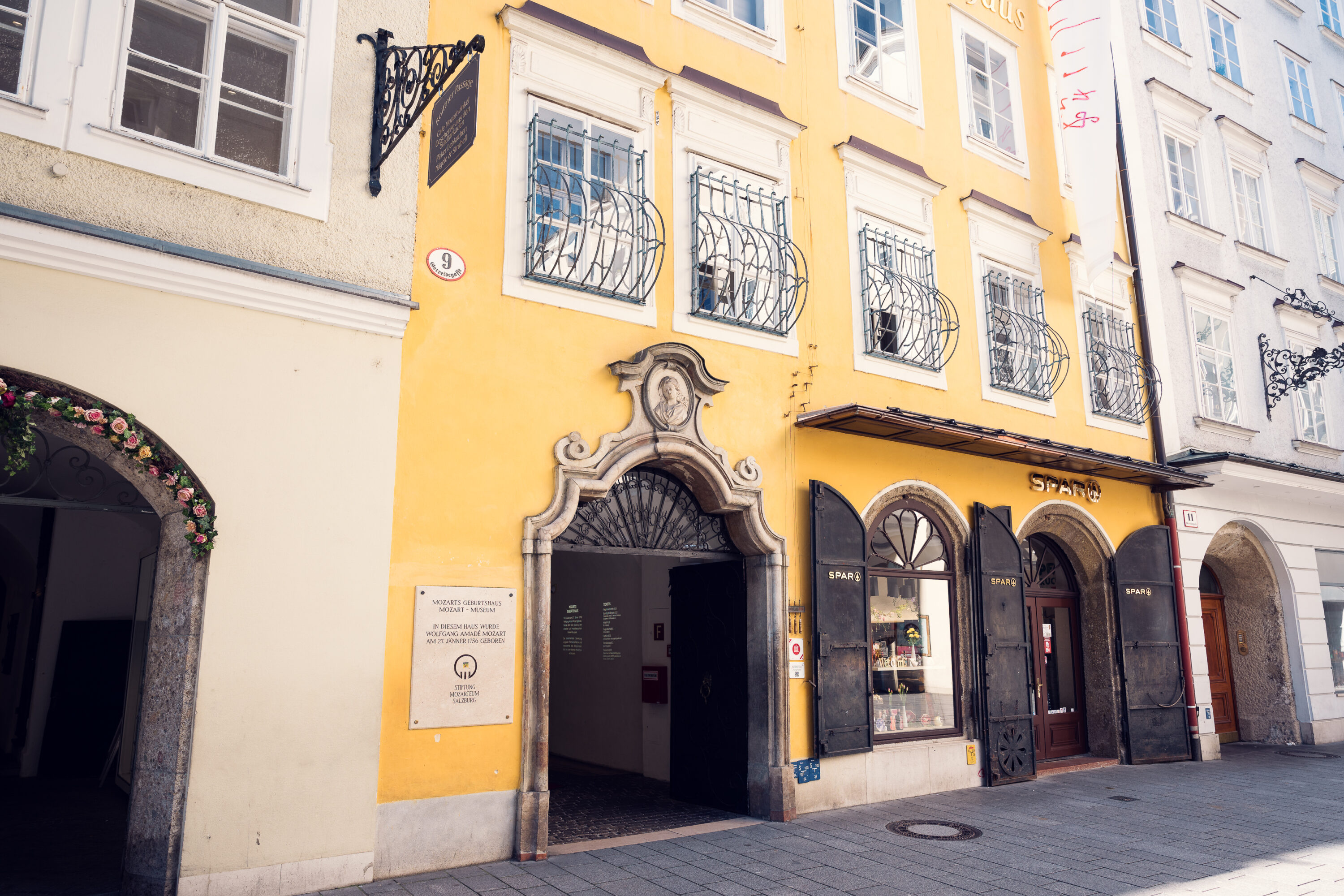
Yellow facade of Mozart's Birthplace at Getreidegasse 9 with wrought iron window grilles.
The yellow facade of Mozart's Birthplace is now home to a museum run by the Mozarteum Foundation.

Guild Signs and the Art of Iron

The wrought-iron signs that line the Getreidegasse aren't merely decorative - they are part of a living craft tradition. Originating in the Middle Ages, when shop owners used visual symbols to identify their trade, these Zunftzeichen became one of the street’s most distinctive features. A baker would display a golden loaf, a locksmith an ornate key, a pharmacist a serpent-wrapped staff.

Today, the tradition still shapes the appearance of the street. The Wieber metalworking shop, located on the Getreidegasse itself, still produces these signs by hand. The result is a visual timeline of commerce: centuries-old guild symbols hanging alongside modern brand interpretations.